African AI Lab Challenges How AI Actually Thinks
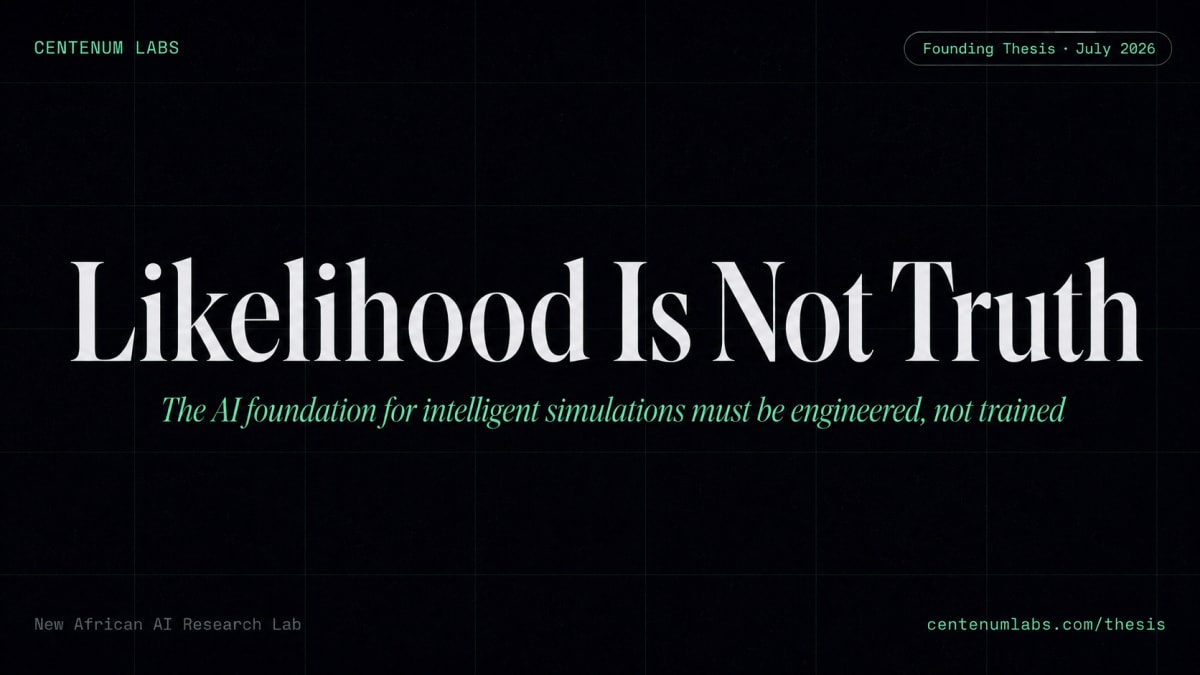
A new research lab in Lagos argues that modern AI is built on the wrong foundation—and they're releasing tools to prove it. Their thesis "Likelihood Is Not Truth" challenges the core assumption driving billion-dollar AI systems.
What if the entire AI industry has been optimizing for the wrong thing? That's the bold claim from Centenum Labs, a new African AI research lab that just published a founding thesis challenging how artificial intelligence actually works.
Modern AI systems are trained to predict what sounds right based on massive amounts of data. Centenum Labs argues this approach has a fatal flaw: sounding plausible isn't the same as being correct.
The Lagos and Toronto-based lab calls this problem "fluent ignorance." AI outputs can be perfectly phrased, structurally coherent, and completely wrong in ways the system itself cannot detect.
"Likelihood measures how plausible an output sounds given a training distribution," said Kingsley Michael, Head of Centenum Labs. "It does not measure whether the output is correct."
The difference matters most in high-stakes situations. Take blood clotting disorders, which the lab uses as an example. Scientists have mapped the clotting cascade for decades, but simulating what happens when medications, genetics, or trauma disrupt it remains dangerously difficult. A wrong answer doesn't look wrong until someone gets hurt.
Centenum Labs is building AI differently. Their systems combine three approaches: neurosymbolic computation, program synthesis, and causal modeling. Together, these allow AI to represent how things actually work, show its reasoning, and be corrected when that reasoning fails.
Their first release proves the concept. MathExec lets users write formulas on a visual canvas and instantly get trained models without coding. An analyst can turn "sales equals price times volume times seasonality" into a working forecast in seconds. A researcher can test neural architectures three times faster than opening traditional coding tools.
The lab focuses on domains where the building blocks are understood but their interactions are complex: bioinformatics, healthcare, and frontier engineering. These are fields where getting the right answer matters more than generating a convincing one.
Why This Inspires
African researchers are doing more than participating in the AI revolution. They're questioning its fundamental assumptions and building alternatives that prioritize truth over plausibility. In a world flooded with convincing-sounding AI outputs, a lab focused on verified reasoning offers something genuinely different.
Co-founded by Emmanuel Efosa-Zuwa and Kingsley Michael, Centenum Labs represents a growing movement of researchers building AI for high-stakes decisions where lives depend on accuracy. Their thesis is available now at centenumlabs.com/thesis.
Sometimes the most important innovation isn't building bigger systems, it's asking whether we've been building them right at all.
Based on reporting by Techpoint Africa
This story was written by BrightWire based on verified news reports.
Spread the positivity!
Share this good news with someone who needs it