Ahmedabad Teaches Waste Sorting at Traffic Lights
While drivers wait at red lights in Ahmedabad, city workers are teaching them how to sort their household trash using four bins. It's turning wasted time into a lesson that could transform India's waste crisis one commuter at a time.
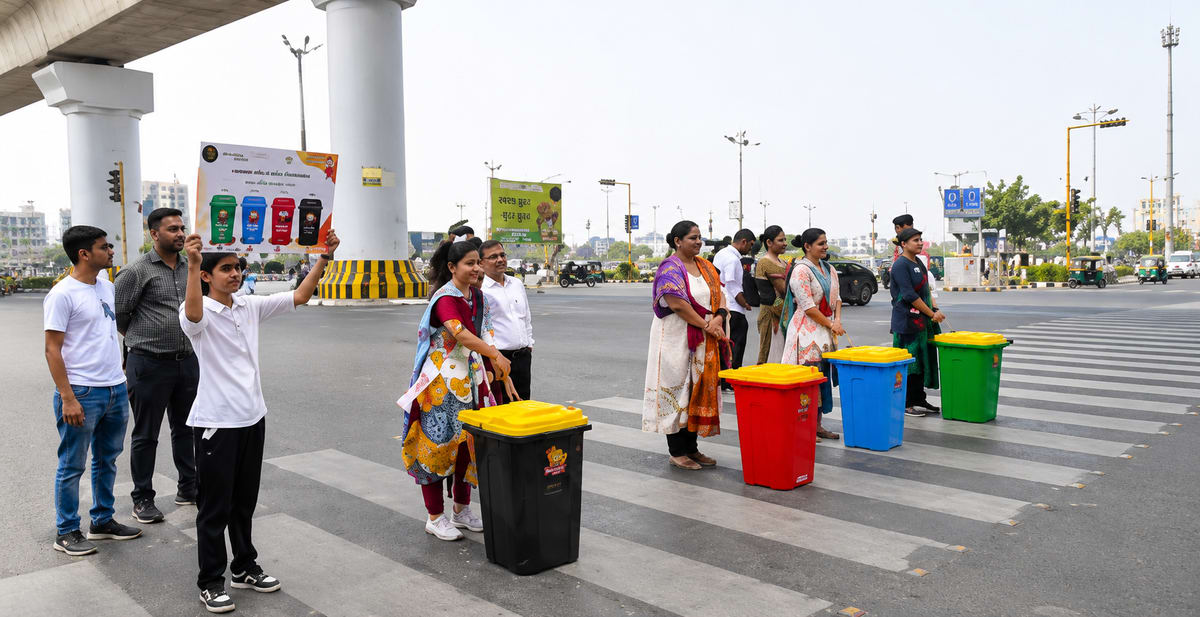
At a busy Ahmedabad intersection, commuters expecting their usual 30 seconds of idling got something unexpected: a crash course in saving their city.
Workers from the Ahmedabad Municipal Corporation stood at the junction holding everyday items—a vegetable peel, a plastic wrapper, a used sanitary pad, an empty medicine strip—and four labeled bins. They asked waiting drivers a simple question: which bin does each belong in?
The roadside quiz wasn't random. It came after India's Supreme Court ruled in February 2026 that cities must get serious about waste segregation, calling clean surroundings a fundamental right connected to life itself.
The court pointed to hard numbers: India generates 170,000 tonnes of municipal solid waste daily, and much of it remains untreated or dumped in landfills. The judges said elected officials must help citizens understand how to separate waste before it even leaves their homes.
Ahmedabad needs the lesson badly. The city produces 3,200 tonnes of waste each day, but only 29% gets sorted properly at the source. The rest travels mixed to the Pirana landfill, where decades of combined trash have poisoned groundwater in nearby neighborhoods.
Between January 2025 and May 2026, the city issued over 354,000 notices for waste violations and collected nearly 17 crore rupees in fines. But fines only catch people after they've done something wrong.
The four-bin system teaches prevention. Wet waste like kitchen scraps goes in one bin for composting. Dry recyclables like paper and plastic need their own clean bin to preserve their value. Sanitary waste must be wrapped separately to protect the workers who handle it. Hazardous items like expired medicines and batteries get their own bin because they can poison soil and water.
For sanitation workers, these small choices made at home become their daily reality. When everything gets mixed into one bag, someone down the line has to sort through food scraps, medical waste, and chemicals by hand.
The Ripple Effect
The demonstration reached hundreds of commuters in just one morning, but its impact spreads wider. Each person who learns the system can teach their household, their neighbors, their building society. When segregation becomes automatic at home, it protects both sanitation workers and the environment.
Other Indian cities watching Ahmedabad's experiment are seeing a template: meet people where they already are, show them exactly what to do, and make the lesson memorable enough to stick after the light turns green. The method costs almost nothing and requires no new infrastructure, just four bins and someone willing to explain them.
The real test happens later, in kitchens and bedrooms across the city when someone holds that vegetable peel or medicine strip and remembers which bin it belongs in. For Ahmedabad to move beyond its current 29% segregation rate, thousands of people will need to recall a 30-second lesson learned while waiting at a red light.
More Images
%2Fenglish-betterindia%2Fmedia%2Fmedia_files%2F2026%2F08%2F14%2F1-2026-08-14-11-20-30.png)
%2Ffilters%3Aformat(webp)%2Fenglish-betterindia%2Fmedia%2Fmedia_files%2F2026%2F08%2F14%2F2-2026-08-14-11-21-00.png)
%2Ffilters%3Aformat(webp)%2Fenglish-betterindia%2Fmedia%2Fmedia_files%2F2026%2F08%2F14%2F3-2026-08-14-11-21-40.png)
Based on reporting by The Better India
This story was written by BrightWire based on verified news reports.
Spread the positivity!
Share this good news with someone who needs it