AI Agents Solve Problems Better With Personalities
Scientists gave AI debate bots human-like personalities and the power to interrupt each other, and they got smarter at solving problems. The messy, chaotic conversations worked better than polite turn-taking.
Picture a work meeting where everyone waits their turn to speak, never interrupts, and sounds exactly the same. Boring, right? That's how most AI systems work today, but researchers just proved there's a better way.
Scientists at The University of Electro-Communications and Japan's National Institute of Advanced Industrial Science and Technology gave AI agents something special: personalities and permission to interrupt. The results surprised even them.
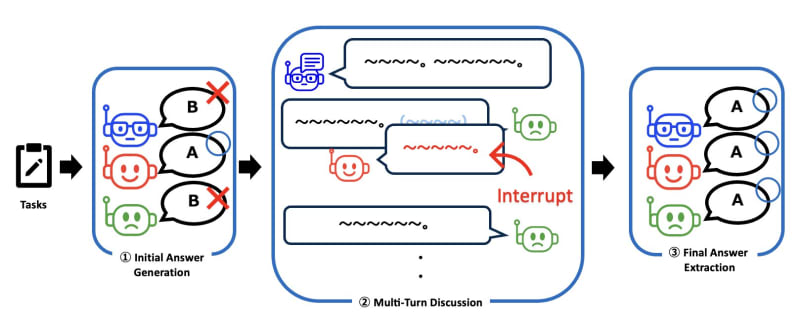
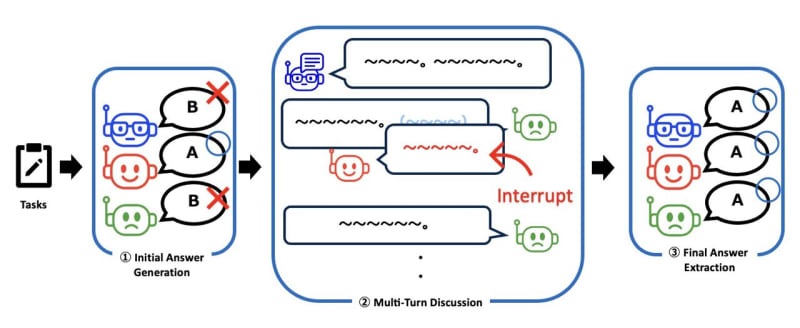
Instead of forcing AI bots to speak in a rigid order, the team let them act more like humans do in real conversations. Some agents became outgoing and assertive. Others turned reflective and careful. Each could jump in when they had something important to say or stay quiet when they didn't.
The secret sauce was an "urgency score." As agents listened to the conversation sentence by sentence, they calculated whether they needed to speak up right away. If an agent spotted a mistake or had a critical insight, it could interrupt immediately. If it had nothing valuable to add, it stayed silent instead of cluttering the discussion.
The team tested their chatty bots using the MMLU benchmark, a challenging test of language understanding across many subjects. The personality-driven agents beat traditional single AI systems in accuracy. They reached better answers faster than generic, rule-following bots.
The Ripple Effect
This breakthrough could reshape how AI helps us solve problems. Imagine customer service bots that actually understand urgency, or AI teams that brainstorm creative solutions without a human moderating every exchange.
The personality traits made a huge difference. Agents with distinct characters worked together more efficiently than identical bots. Some jumped in with bold ideas while others caught errors with careful analysis. The mix of styles prevented both awkward silence and useless chatter.
Lead researcher Yuichi Sei notes that current multi-agent systems feel artificial because they lack the messy dynamics of human conversation. This study proves that adding social cues we take for granted actually makes AI smarter, not more chaotic.
The team plans to expand this framework to creative and collaborative tasks next. They want to understand how digital personalities influence group decisions in everything from product design to scientific research.
The future of AI collaboration might not be stricter controls but embracing the beautiful chaos of how humans actually work together.
More Images


Based on reporting by Phys.org - Technology
This story was written by BrightWire based on verified news reports.
Spread the positivity!
Share this good news with someone who needs it