AI Cuts Drug Discovery Time from 14 Years to Just Months
Artificial intelligence is slashing the time and cost to develop new medicines, opening doors for treatments that were previously too expensive to pursue. The first AI-designed drugs are already in human trials.
Creating a new drug used to take 14 years and cost up to $2.6 billion, with only 12% of attempts succeeding. Those brutal economics meant pharmaceutical companies ignored rare diseases affecting 446 million people worldwide because the payoff wasn't worth the risk.
Now AI is rewriting those rules. Companies like Insilico Medicine, Recursion, and Absci are using artificial intelligence to design drugs in months instead of years, dramatically cutting costs and expanding which diseases are worth fighting.
The transformation builds on decades of progress. In the 1970s, scientists started using computers to model how molecules interact with disease targets. By the 2000s, researchers had massive digital libraries of chemical structures to search through. But real breakthroughs arrived in the 2020s when deep learning AI could predict how promising a drug candidate would be with unprecedented accuracy.
Today's AI tools do what once seemed impossible. They generate entirely new molecular structures tailored to attack specific diseases. They predict which compounds will work in human bodies before a single experiment happens. Some platforms even connect directly to automated labs that can test thousands of AI suggestions simultaneously.
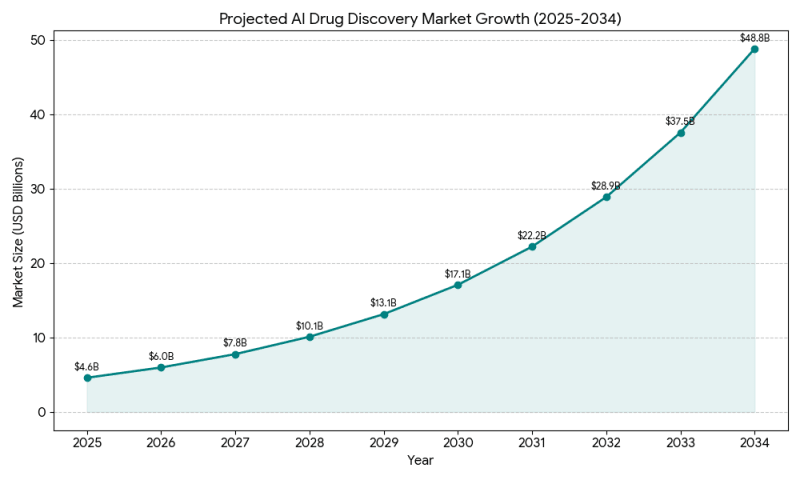
The results speak for themselves. The AI drug discovery market is projected to explode from $4.6 billion in 2025 to $49.5 billion by 2034. The first medicines designed by artificial intelligence are now being tested in human clinical trials.
The technology works through several clever approaches. Convolutional neural networks analyze molecular structures like reading blueprints. Graph neural networks map relationships between atoms to predict how they'll behave. Each method helps researchers skip years of trial and error that used to define drug development.
The Ripple Effect spreads far beyond faster timelines. Rare diseases that affect small patient populations are suddenly economically viable to treat. A condition impacting 10,000 people might have been ignored when drug development cost billions, but AI makes those numbers work. Patients who never had hope for treatment now have companies actively working on their diseases.
The shift also means fewer failed drugs draining resources. When a late-stage trial fails today, companies lose $800 million to $1.4 billion in wasted investment. AI catches problems earlier and cheaper, freeing up money to pursue more treatments for more people.
Major pharmaceutical companies are racing to adopt these tools because the economics are impossible to ignore. Rising research costs were making drug development unsustainable, but AI offers a path to maintain innovation while controlling expenses.
The future promises even faster progress as AI systems learn from each success and failure, becoming smarter with every drug they help create.
More Images

Based on reporting by Google News - Clinical Trial Success
This story was written by BrightWire based on verified news reports.
Spread the positivity!
Share this good news with someone who needs it