AI Cuts Solar Panel Recycling Time From Years to Months
Australian scientists are using artificial intelligence and robots to crack one of solar energy's toughest puzzles: recycling panels without losing their most valuable materials. The breakthrough could turn a million tonnes of future waste into over $1 billion in recovered resources.
Scientists in Australia just figured out how to rescue the most valuable parts of old solar panels, and they're doing it at lightning speed thanks to AI that works while humans sleep.
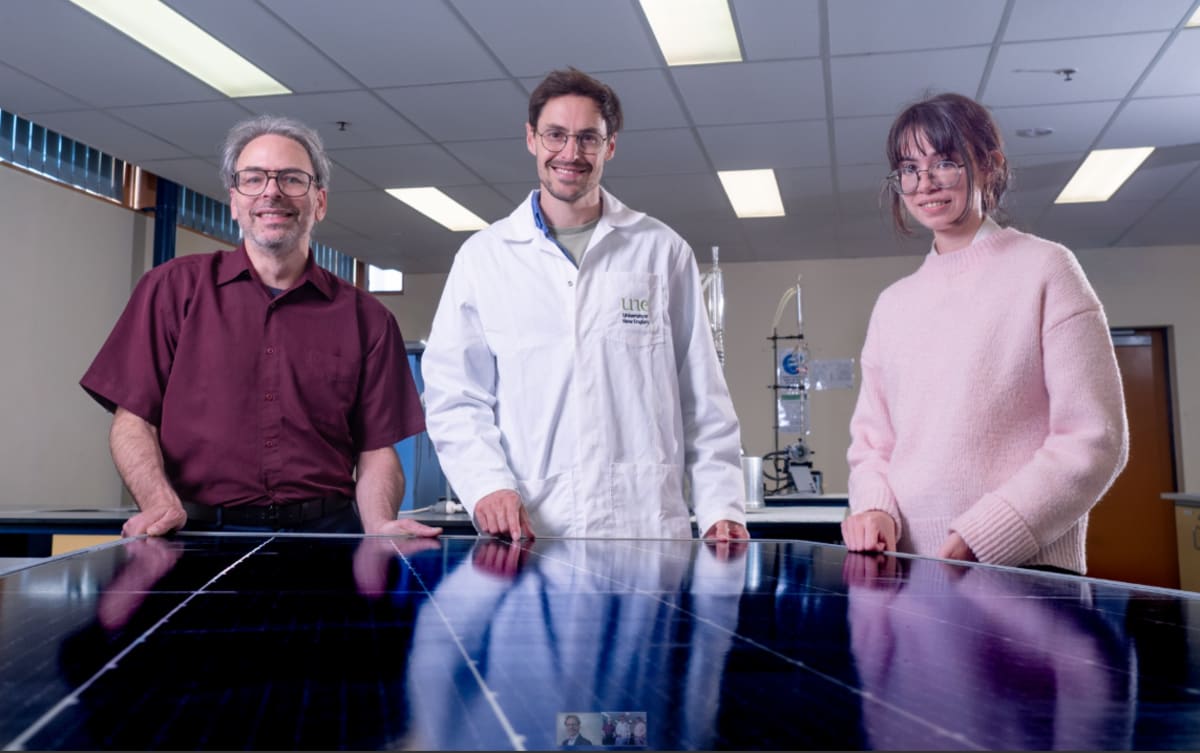
Researchers at the University of New England are using artificial intelligence and supercomputers to identify chemical formulas that can cleanly separate silicon from retired solar panels. Silicon is the priciest component in solar technology, but until now, recycling couldn't restore it to its original purity because of protective coatings applied during manufacturing.
The team's AI runs quantum chemical simulations to test thousands of potential solutions at the molecular level. Instead of spending years in traditional trial and error, the technology predicts exactly how to take panels apart atom by atom.
"These technologies are giving an exponential boost to the process of scientific discovery," said computational chemist Kasimir Gregory. The AI creates predictions, a $1.9 million robotic laboratory physically produces the recommended solvents, and autonomous AI agents run experiments around the clock with minimal human help.
Research director Amir Karton said this creates "an efficient feedback loop between AI-driven predictions and experimental observations." Development that once took years now happens in months.
The timing couldn't be better. Australia expects to face one million tonnes of dead solar panels by 2035, representing over $1 billion in potentially recoverable materials.
ACEN Australia, a renewable energy developer, is already supporting the research by supplying panels from its 720 MW New England Solar Project. The company's Stubbo Solar Project recently became the first large-scale installation to earn Circular PV Alliance certification for its recycling commitments.
The Ripple Effect
This breakthrough does more than solve a waste problem. It keeps valuable resources local instead of shipping thousands of tonnes across the country for processing.
Managing Director David Pollington said the company is "extra excited that this industry-leading research is happening right here in the New England," supporting both environmental goals and regional development. The University of New England launched its Institute for Strategic Artificial Intelligence in May 2026 specifically to ensure renewable energy growth benefits local communities while serving national needs.
The institute operates from LabNext70, Australia's first purpose-built AI research hub focused on education, and will expand this approach across materials science, education, and strategic decision-making.
Tomorrow's solar waste is becoming today's treasure, one AI-powered experiment at a time.
More Images

Based on reporting by PV Magazine
This story was written by BrightWire based on verified news reports.
Spread the positivity!
Share this good news with someone who needs it