AI Drone Beats World Champion Pilots in Abu Dhabi Race
A lightweight racing drone powered by artificial intelligence just outpaced three former world champion human pilots on a demanding course, reaching speeds over 60 mph using only a single camera and tiny onboard computer. The breakthrough proves that sophisticated AI doesn't need massive computing power to perform at superhuman levels.
An AI-powered racing drone just proved that machines can outfly the world's best human pilots without any of the high-tech sensors you'd expect.
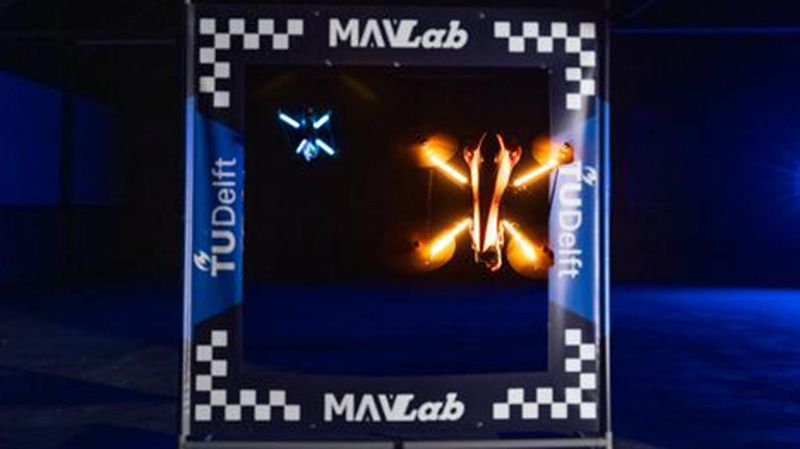
Scientists at Delft University of Technology in the Netherlands created MonoRace, a system that navigates race courses using nothing more than one forward-facing camera and a computer smaller than your phone. The drone won the 2025 Abu Dhabi Autonomous Racing League, beating every rival autonomous team and posting faster lap times than three former human world champions.
MonoRace completed two laps around 11 gates in just 16.56 seconds, hitting a top speed of 63 mph. The entire 2.13-pound drone operates without GPS, external cameras, or any preloaded map of the course.
The secret lies in how the AI learned to fly. Researchers trained the system through millions of simulated attempts, letting it crash and retry until it mastered translating what it sees into split-second motor commands. The AI sends instructions to its four propellers 500 times per second, banking sharply through gates and accelerating with precision no human reflexes could match.
What makes this breakthrough remarkable isn't just the speed. The team deliberately varied training conditions, simulating different weights, voltages, and even propeller damage so the AI could handle real-world imperfections. The result is a system that adapts to whatever drone it controls.
Why This Inspires
This technology represents a giant leap for physical AI, showing that robots can perceive, decide, and act at high speeds without massive computing power. The control network runs on a microcontroller-class chip, the kind found in everyday devices.
Professor Guido de Croon, who led the research published in Science Robotics, sees applications far beyond racing. The same neural network approach could optimize for energy efficiency instead of speed, potentially reducing power consumption across all kinds of robotics and machines.
MonoRace could even become a training tool for human pilots, similar to how chess programs helped players improve their game. When machines push the boundaries of what's possible, humans often find new ways to level up their own skills.
The breakthrough proves that the future of AI isn't just about bigger computers and more sensors. Sometimes the smartest solutions come in the smallest, most efficient packages.
More Images

Based on reporting by Live Science
This story was written by BrightWire based on verified news reports.
Building Something New? Try the BrightWire Tech Stack Advisor
Compare modern frameworks, cloud hosting, and AI tools tailored to your project budget and scale.
Spread the positivity!
Share this good news with someone who needs it