AI Finds 1,300 Hidden Cosmic Wonders in Hubble Data
Scientists used artificial intelligence to discover more than 1,300 rare cosmic objects hidden in 35 years of Hubble Space Telescope images. Most had never been documented before.
Thirty-five years of Hubble Space Telescope data just revealed over 1,300 cosmic treasures that were hiding in plain sight, thanks to a smart new AI tool that can do in days what would take humans decades.
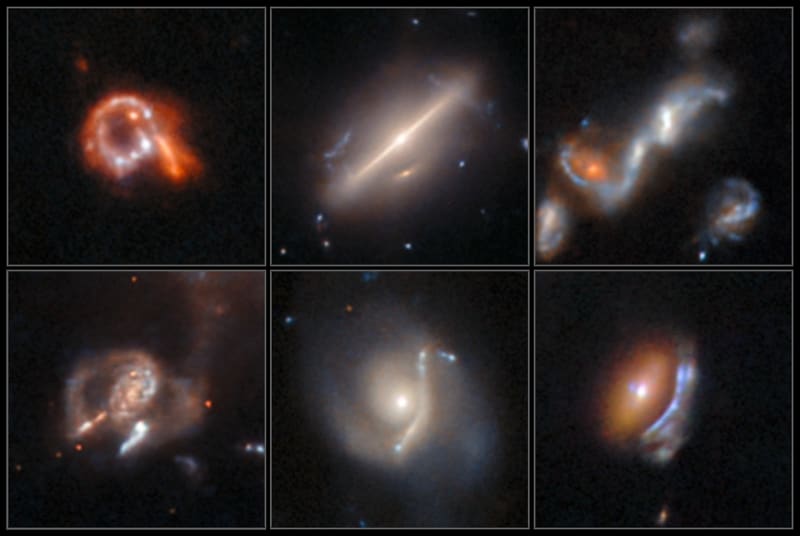
Astronomers David O'Ryan and Pablo Gómez from the European Space Agency created a neural network called AnomalyMatch to hunt through nearly 100 million tiny images from Hubble's vast archive. In just two and a half days, the AI flagged these rare astronomical oddities that human experts simply didn't have time to find.
More than 800 of the discoveries had never appeared in scientific literature. The cosmic lineup includes colliding galaxies leaving trails of stars and gas, gravitational lenses bending light into arcs and rings, galaxies with jellyfish-like tentacles, and planet-forming disks that look like hamburgers floating in space.
What makes this especially exciting is that several dozen objects don't fit any existing classification. They're so unusual that astronomers need to create entirely new categories to describe them.
The challenge these researchers tackled is massive. Never before in human history have astronomers had access to this much observational data. Manual review would be impossible, and even citizen science projects can't keep pace with archives as large as Hubble's.
The Ripple Effect
This breakthrough comes at the perfect time. NASA's upcoming Nancy Grace Roman Space Telescope, along with ESA's Euclid mission and the Vera C. Rubin Observatory, will soon flood scientists with unprecedented volumes of new images.
Tools like AnomalyMatch won't just help astronomers catch up with existing data. They'll make it possible to discover unexpected phenomena in real time as new observations pour in. That means finding cosmic objects we've never even imagined before.
The technique mimics how the human brain recognizes patterns, but at superhuman speed. It learned to spot what makes an object unusual by studying countless examples, then applied that knowledge across millions of archived images.
The discoveries prove that even well-studied datasets hold secrets waiting to be unlocked. Hubble has been our window to the universe for over three decades, and this AI just showed us we were only seeing part of the view.
This new approach to exploring space data means more surprises are coming, hidden in both old archives and future observations that will help us understand our universe in ways we never could before.
More Images



Based on reporting by Google: NASA discovery
This story was written by BrightWire based on verified news reports.
Spread the positivity!
Share this good news with someone who needs it