AI Glove Helps Stroke Patients Move Again in India
A new device reads brain signals and moves paralyzed hands at the exact moment patients try to move them. The technology could bring advanced rehabilitation to over a million stroke survivors in India who lose hand function every year.
When a stroke damages the brain, the muscles often survive intact. What breaks is the invisible highway between intention and action, leaving patients who desperately want to close their hand watching it refuse to obey.
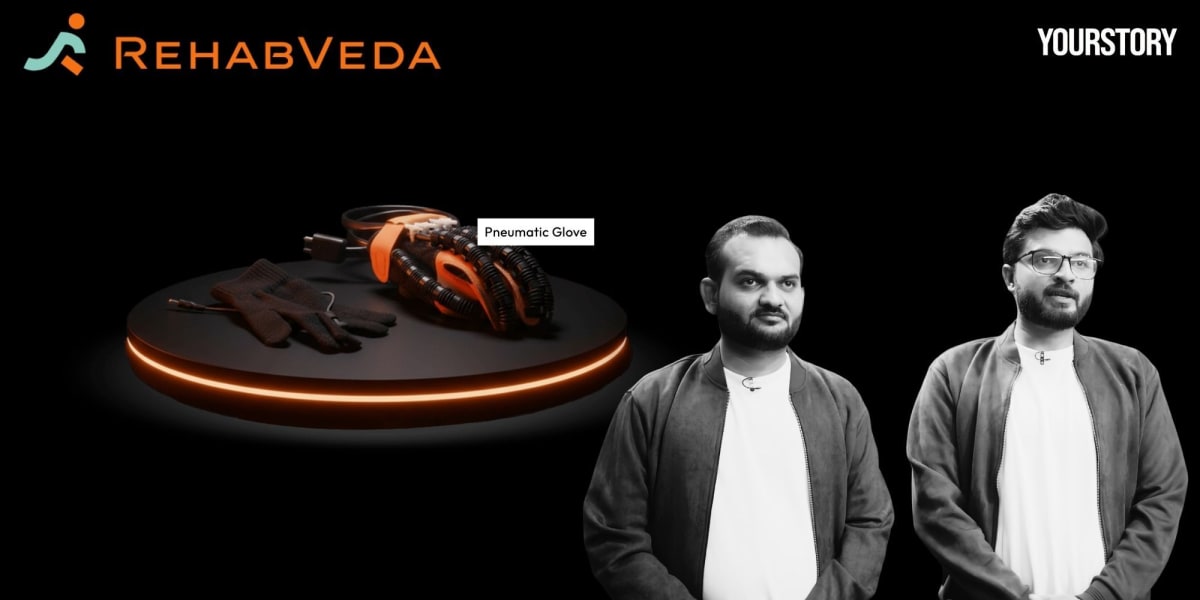
RehabVeda, developed by Nexactly AI Solutions in Ahmedabad, is trying to rebuild that highway. Their R1 System uses an EEG headband to read electrical brain activity, software that detects when a patient is trying to move, and a pneumatic glove that closes the hand at that precise moment.
The timing matters. When the brain sends a signal and immediately sees the hand respond, even artificially, it starts to rebuild the damaged connection. Think of it as teaching the brain a new route around the roadblock.
India sees over a million new stroke cases every year, and hand function is one of the slowest things to return. Most patients stop therapy long before recovery peaks because therapists are expensive, concentrated in cities, and can only work with so many people in a day.
The company spent five years developing the system at IIT Roorkee, supported by government research programs and innovation hubs. They raised 50 lakh rupees in pre-seed funding from IIT Roorkee and secured a deal on Shark Tank India Season 5 from two investors. They were also selected for Bharat Innovates 2026, which brought Indian deep-tech companies to France.
The team includes physiotherapists working alongside engineers, and they claim to have expanded into the United States, Singapore and Europe. In their own trials, they report 80 percent of patients showed improvement in hand function, though those results have not yet been published in peer-reviewed journals or received regulatory clearance.
Brain-computer interfaces like this are an active research field worldwide, with promising laboratory results and a tougher track record in real clinical settings. EEG signals are faint and vary between people and even between sessions, making it technically challenging to separate true movement intention from background brain noise.
Why This Inspires
What makes this hopeful is not just the technology but the problem it tackles. Stroke rehabilitation works when patients practice movements thousands of times, but most people in India cannot afford that many hours with a therapist. A device that automates part of that process could put recovery within reach for families who would otherwise go without. The science still needs validation, but the direction points toward making advanced care accessible, not just possible.
The road from laboratory to clinic is long, but at least someone is building it.
More Images


Based on reporting by YourStory India
This story was written by BrightWire based on verified news reports.
Spread the positivity!
Share this good news with someone who needs it