AI Goggles Turn Lab Rookies Into Experts in Just One Week
Smart goggles with AI are watching scientists' hands in real time, catching mistakes before they happen and training beginners to perform like seasoned researchers. In tests, novices wearing the system produced results identical to expert scientists after just seven days of training.
Scientists with one week of training are now producing lab results that match seasoned experts, thanks to AI-powered goggles that watch their every move.
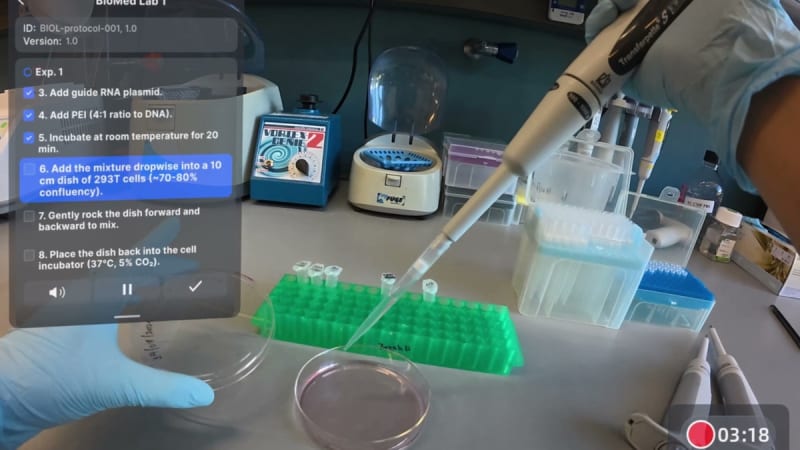
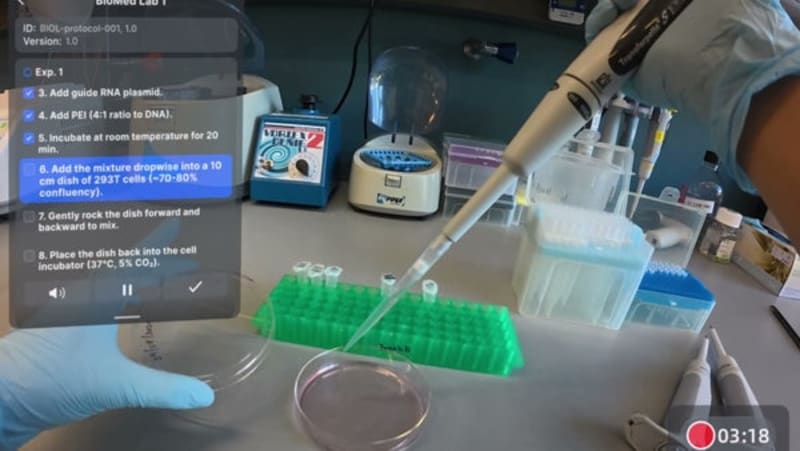
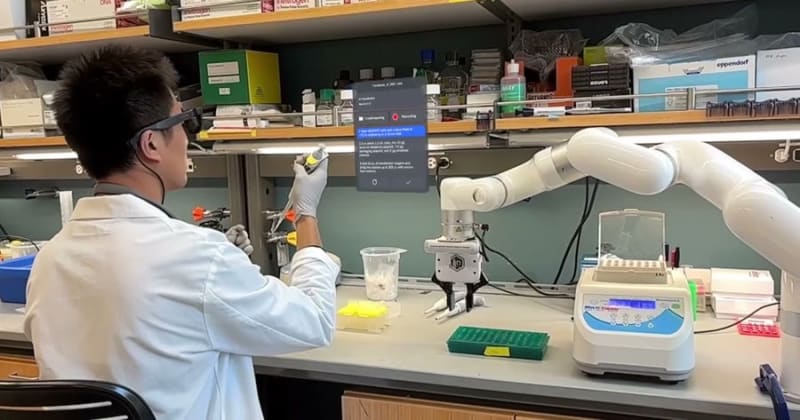
The system, called LabOS, combines smart glasses with artificial intelligence to guide researchers through complex experiments step by step. A tiny camera in the frame monitors their hands, and a display inside the goggles alerts them instantly if they reach for the wrong tube or skip a critical step.
Stanford bioengineer Le Cong and Princeton computer scientist Mengdi Wang led the team that created this technology. Their goal was simple: help scientists avoid the small mistakes that can ruin months of work. A reagent added at the wrong temperature or a contaminated pipette tip might seem minor, but these tiny errors wreck experiments more often than most people realize.
The science community has struggled with this problem for years. A 2016 survey found that over 70% of researchers couldn't reproduce another scientist's experiments, and more than half couldn't even replicate their own work. Human error during repetitive lab tasks is a major culprit.
LabOS treats every experiment like a learning opportunity for both humans and machines. The AI compares what it sees through the goggles against the written protocol, offering real time guidance while collecting data about what works and what doesn't. When experiments fail, the system can analyze exactly which steps caused problems and suggest improvements for the next attempt.
The results speak for themselves. Junior scientists using LabOS for just one week performed a complex protein procedure with results identical to those of experts. Cong, as their professor, couldn't tell the difference between novice and expert work.
The technology isn't limited to research labs either. The team recently launched MedOS, adapting the same AI and augmented reality system to help surgeons with anatomical mapping and tool alignment during operations.
Why This Inspires
This breakthrough tackles one of science's most frustrating problems: brilliant research ideas getting derailed by preventable human mistakes. By catching errors before they happen, LabOS frees scientists to focus on discovery rather than damage control.
The system also democratizes expertise. Traditionally, mastering complex lab techniques took months or years of practice. Now researchers can achieve expert level results in days, accelerating the pace of scientific discovery across every field.
Wang envisions a future where every scientific lab and clinic becomes what she calls "AI perceivable and AI operable." The technology could train professionals faster, reduce costly mistakes, and ultimately improve outcomes for everyone who depends on accurate scientific research.
Smart goggles might seem like science fiction, but they're already turning rookies into experts one experiment at a time.
More Images


Based on reporting by Scientific American
This story was written by BrightWire based on verified news reports.
Spread the positivity!
Share this good news with someone who needs it