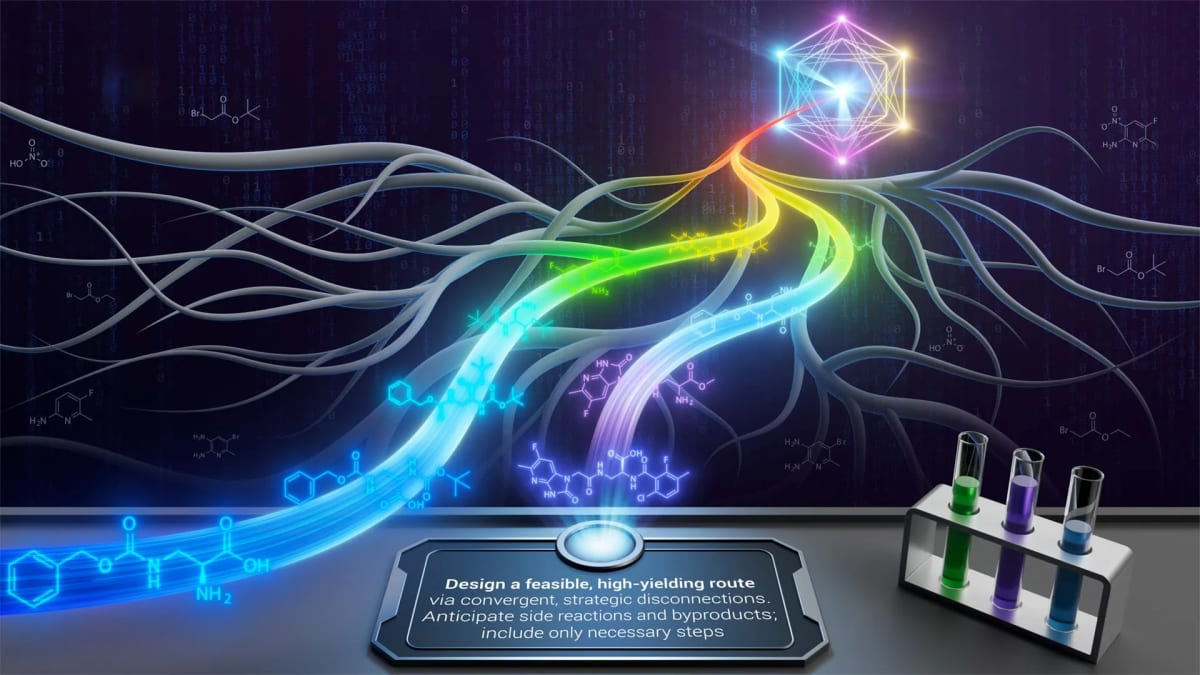
AI Lets Chemists Design Molecules Using Plain Language
Scientists at EPFL created an AI that understands everyday instructions to design complex molecules, turning years of specialized expertise into simple conversations. The breakthrough could speed up drug discovery and make advanced chemistry tools accessible to more researchers.
Imagine designing a life-saving drug by simply describing what you want in plain English. That's exactly what scientists at Switzerland's EPFL have made possible with a new AI system called Synthegy.
Creating new molecules has always been one of chemistry's toughest challenges. Whether building medications or cutting-edge materials, chemists must plan countless steps backward from their target compound, a process called retrosynthesis that typically requires years of training and strategic thinking.
The hardest part has been the decision-making. Should you form this ring structure first or later? Which building blocks make the most sense? Do sensitive parts need protection during synthesis? Computers could search millions of possibilities, but they lacked the intuition of experienced chemists.
Synthegy changes that by combining traditional search algorithms with large language models that act as reasoning guides. Instead of forcing chemists to use complicated filters and rules, the system simply listens to natural language instructions and finds pathways that match.
Here's how it works: A chemist types a simple request like "form this ring early" or "avoid unnecessary protecting groups." The software generates possible pathways, converts them to text, and has the AI evaluate each option against the instructions. The system then scores the best routes and explains its reasoning.
The framework handles reaction mechanisms too, breaking down how electrons move during chemical reactions step by step. This helps scientists predict new reactions, improve efficiency, and avoid costly trial and error in the lab.
The Ripple Effect
When 36 chemists tested Synthegy in a double-blind study, their assessments matched the AI's recommendations 71% of the time. The system successfully identified pathways that met complex strategic requirements, flagged unnecessary steps, and prioritized practical solutions.
Lead researcher Andres Bran explains the bigger vision: "We're bridging the gap between synthesis planning and mechanisms computationally through a unified natural language interface. This connection could help us discover new reactions that enable us to synthesize new molecules."
The implications reach far beyond the lab. Faster, more accessible molecular design could accelerate drug discovery, helping medications reach patients sooner. It could democratize advanced chemistry tools, allowing researchers without decades of specialized training to tackle complex problems.
Philippe Schwaller's team at EPFL designed Synthegy not to replace human expertise but to amplify it. The AI serves as a collaborative partner, translating a chemist's strategic thinking into computational power and offering solutions that reflect their goals.
The system already shows that AI can operate at multiple levels, from analyzing individual functional groups to evaluating entire synthetic routes. As the technology improves, it promises to make one of science's most demanding tasks feel more like a conversation.
Chemistry just got a whole lot more conversational, and the future of molecular design looks brighter because of it.
Based on reporting by Science Daily
This story was written by BrightWire based on verified news reports.
Spread the positivity!
Share this good news with someone who needs it