AI Model Trained on 1 Billion Experiments Predicts Cell Behavior
Scientists at Arc Institute are building a "virtual cell" powered by AI that could revolutionize how we understand and treat diseases like Alzheimer's and cancer. The model learns from a billion biological experiments to predict what goes wrong in human cells and how to fix it.
Scientists just achieved something that sounds like science fiction: teaching artificial intelligence to read the language of human cells.
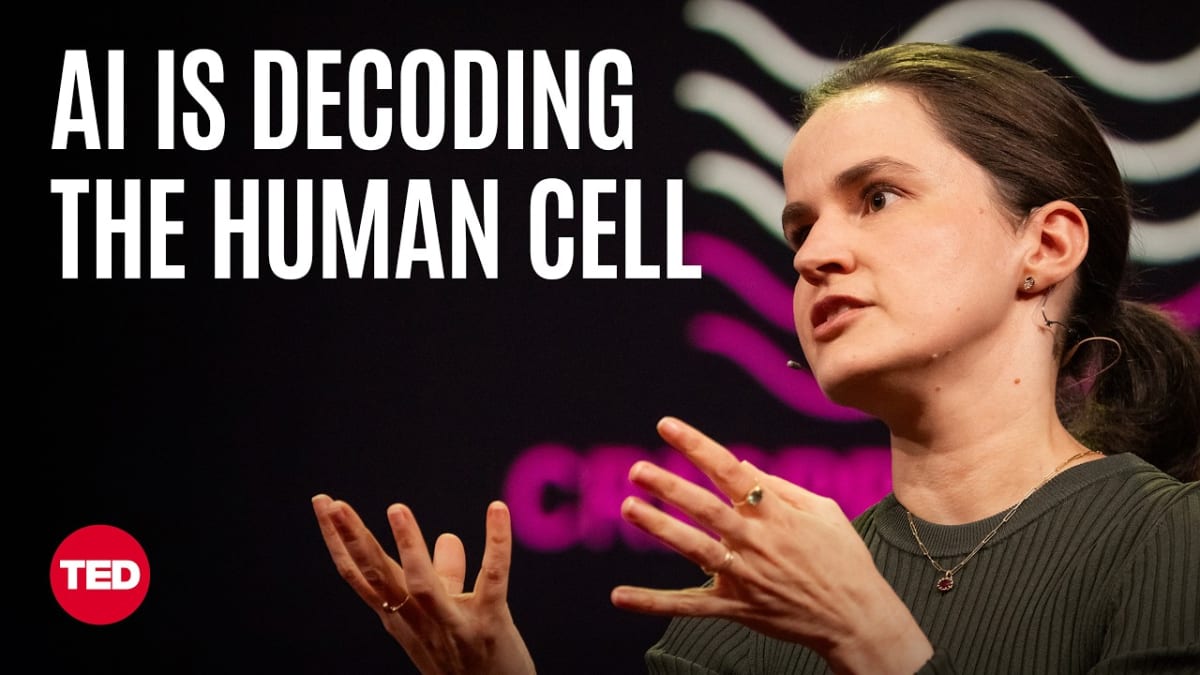
Silvana Konermann and her team at Arc Institute are tackling one of medicine's biggest mysteries. Despite decades of research, complex diseases like Alzheimer's and cancer remain stubbornly difficult to solve. The problem isn't lack of effort. It's that human cells are wildly complex, and we've been missing a universal translator.
Enter the "virtual cell," an AI model that's learning biology at a scale never before possible. The system trains on data from a billion biological experiments, absorbing patterns that no human researcher could spot alone.
Think of it like teaching a computer to become fluent in cell biology. Just as AI learned to understand and generate human language, this technology is learning to interpret what cells are doing, predict when something goes wrong, and suggest how to fix it.
The implications stretch far beyond the laboratory. This approach could fundamentally transform drug discovery, turning a process that typically takes over a decade into something faster and more precise.
Konermann presented this ambitious vision at TED2026 in conversation with Chris Anderson. The project is part of The Audacious Project, TED's initiative to fund bold ideas that could change the world.
The Ripple Effect
Understanding cellular language at this scale could unlock answers to questions that have puzzled medical researchers for generations. When you can predict how millions of cellular interactions play out, you can design treatments with unprecedented precision.
The virtual cell doesn't replace human scientists. Instead, it amplifies their capabilities, processing massive datasets to reveal insights that would take human teams years to uncover. It's collaboration between human creativity and machine learning power.
This work represents a shift in how we approach the toughest medical challenges. Rather than studying diseases one experiment at a time, researchers can now simulate countless scenarios, testing hypotheses in virtual space before moving to the real world.
The technology is still developing, but the foundation is solid. Each experiment that feeds into the system makes it smarter, building toward a future where personalized medicine isn't just possible but practical.
Medical breakthroughs often require someone to ask a different question, and Konermann's team chose a big one: what if we could teach computers to think like cells?
Based on reporting by TED
This story was written by BrightWire based on verified news reports.
Spread the positivity!
Share this good news with someone who needs it