AI Now Designs Physics Experiments Scientists Never Imagined
Artificial intelligence is designing breakthrough physics experiments from scratch, discovering layouts that outperform human designs and opening entirely new ways to explore the universe. Scientists are using AI to navigate billions of possible configurations, finding solutions that challenge conventional wisdom.
Scientists just gained a powerful new lab partner that never sleeps and can explore billions of experimental possibilities in the time it takes us to drink our morning coffee.
Artificial intelligence is moving beyond simply tweaking existing physics experiments to designing entirely new ones from the ground up. These AI-created configurations often look nothing like traditional setups, yet they match or exceed what human experts have developed over decades.
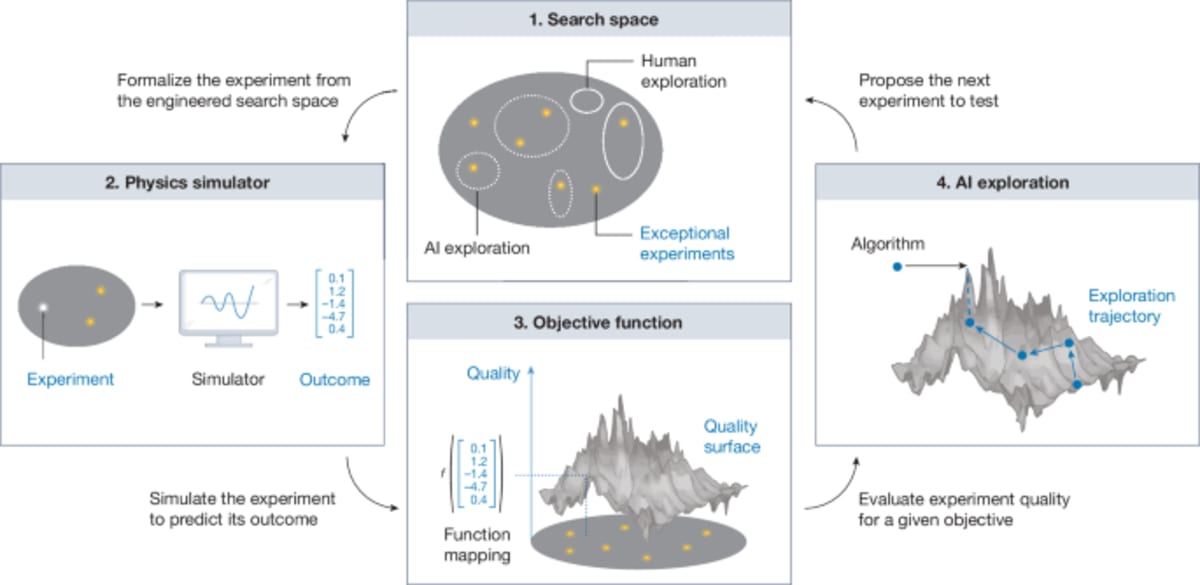
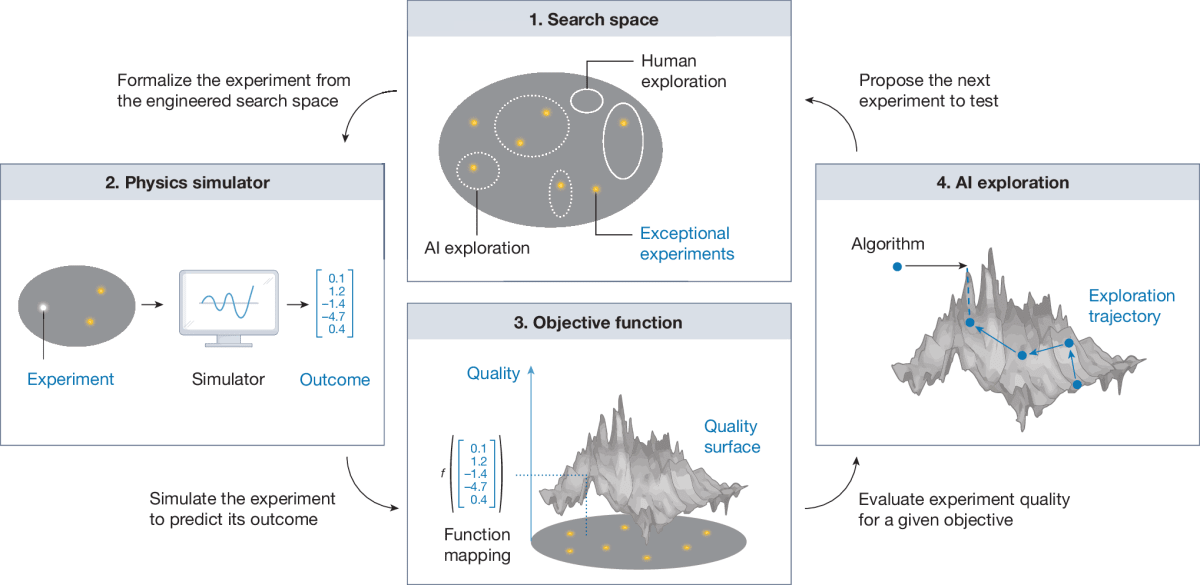
The breakthrough centers on four key challenges that researchers have now cracked. First, they built search spaces that let AI explore countless hardware arrangements while respecting real-world constraints like budget and available materials. Second, they created lightning-fast simulators that can predict how each design will perform without building expensive prototypes.
Third, scientists translated complex research goals into mathematical objectives that computers can optimize. Fourth, they developed AI methods that can handle both small adjustments and radical redesigns at the same time.
The results already exist in real laboratories. An early AI framework called Melvin designed photonic quantum experiments that human researchers later built and successfully operated. Another system called PyTheus discovered 100 diverse quantum optics experiments by exploring an intentionally flexible design space inspired by physics principles.
These AI tools have improved particle detector designs, optimized fusion reactor configurations, and created new types of quantum gates. In one striking example, AI discovered experiments involving "entanglement by path identity," a quantum phenomenon that researchers then confirmed experimentally.
The Ripple Effect
The implications stretch far beyond any single experiment. As AI simulators learn to span multiple physics domains simultaneously, they could propose experimental concepts that bridge different fields in ways human intuition rarely considers.
This approach democratizes innovation too. Smaller research teams without decades of experimental tradition can now explore design possibilities previously accessible only to the most experienced labs. Graduate students can test wild ideas computationally before committing precious lab resources.
The AI doesn't replace human creativity but amplifies it. Researchers still define the scientific questions and interpret the results. But now they have a tireless collaborator that can explore the vast middle ground between "what we've always done" and "what might be possible."
Looking ahead, these systems could tackle increasingly ambitious goals by optimizing for multiple objectives at once, balancing performance against cost, construction difficulty, and experimental reliability. The same techniques improving quantum optics experiments today might tomorrow redesign gravitational wave detectors or propose entirely new ways to search for dark matter.
The universe just became a little more knowable, thanks to machines that can imagine experiments we never thought to try.
More Images
Based on reporting by Nature News
This story was written by BrightWire based on verified news reports.
Spread the positivity!
Share this good news with someone who needs it