AI Racing Drone Beats Human Champions in Abu Dhabi
An AI-powered racing drone from Dutch engineers just beat top human pilots in a major international competition for the first time ever. The lightweight drone mastered high-speed racing using minimal sensors, proving smart machines can thrive in the unpredictable real world.
A lightweight drone powered by artificial intelligence just made history by defeating champion human pilots at an intense racing competition in Abu Dhabi, marking the first time AI has beaten humans at their own game outside a controlled lab.
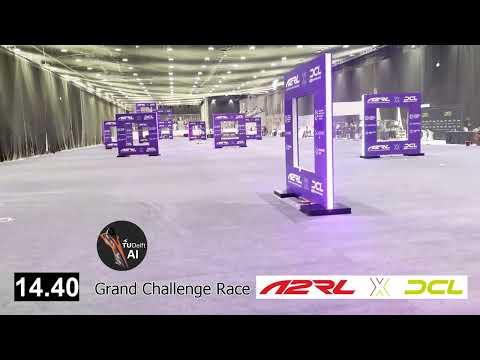
Engineers at Delft University of Technology in the Netherlands built MonoRace, a smart quadcopter that navigated a treacherous obstacle course at speeds up to 100 miles per hour. The drone zipped through small gates and tight corners, outpacing several human champions who use special goggles to pilot their drones in first-person view.
This victory represents something bigger than just winning a race. While AI has famously beaten humans at chess, Go, and video games, those triumphs happened in perfectly controlled digital worlds where conditions never change.
MonoRace proved AI can adapt to messy, real-world challenges. The team deliberately equipped their drone with minimal hardware: just one camera and basic motion sensors that track acceleration and rotation.
The race happened in November 2024, but researchers published the full scientific details this week in the journal Science Robotics. Their breakthrough shows that less can actually be more when designing intelligent machines.
"Instead of giving the robot increasingly powerful sensors and computers, we wanted to find out how much intelligence we could extract from very limited resources," explained aerospace engineer Christophe De Wagter. The extreme racing environment pushed the team to develop AI that wasn't just fast but genuinely robust.
The Ripple Effect
This achievement opens doors far beyond recreational racing. The same technology that helps MonoRace navigate tight spaces at breakneck speeds could revolutionize search and rescue operations, help drones deliver medicine to remote areas, or inspect dangerous infrastructure like bridges and power lines.
MonoRace succeeded where previous AI drones struggled by combining camera vision with motion sensors to understand exactly where it sits on the track. When lighting changes or visibility drops, issues that crippled earlier racing drones, MonoRace adapts and keeps flying.
Three years ago, another team from the University of Zurich built Swift, an AI drone that beat humans in a small indoor lab. But Swift's performance collapsed when conditions shifted even slightly, like when someone adjusted the lighting.
MonoRace represents the evolution: a machine that learns to handle whatever the real world throws at it.
The win proves we don't always need bigger, more powerful technology to solve hard problems. Sometimes the smartest solution comes from teaching machines to do more with less, just like humans have learned to do for millennia.
More Images



Based on reporting by Google News - World Record
This story was written by BrightWire based on verified news reports.
Building Something New? Try the BrightWire Tech Stack Advisor
Compare modern frameworks, cloud hosting, and AI tools tailored to your project budget and scale.
Spread the positivity!
Share this good news with someone who needs it