AI Reveals Ancient Roman Game Board From 1,700 Years Ago
Scientists used artificial intelligence to solve a centuries-old mystery about a Roman stone artifact found in the Netherlands. The discovery proves a type of board game existed in Europe 1,000 years earlier than historians thought.
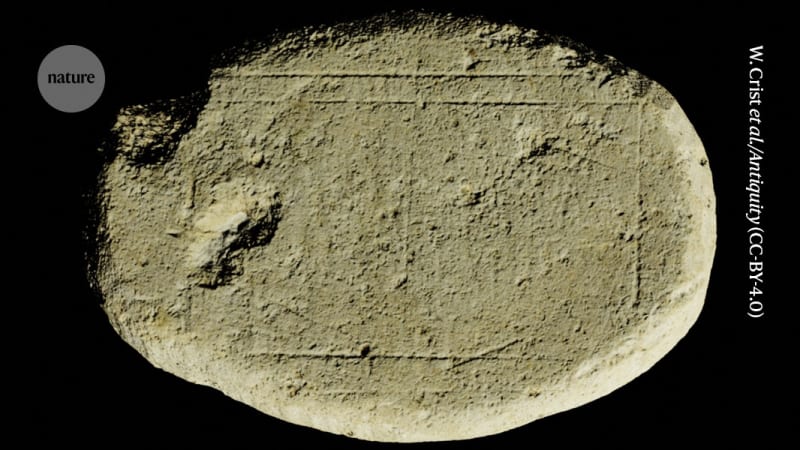
A mysterious stone object buried for nearly two millennia in what is now the southern Netherlands has finally revealed its secret with help from modern artificial intelligence.
Researchers at Leiden University confirmed the ancient Roman artifact was a board game that predates similar games in Europe by roughly 1,000 years. The stone, long suspected to be some kind of gaming piece, turned out to be a "blocking game" that historians didn't think existed in Europe until the Middle Ages.
Walter Crist and his team used AI simulations to analyze microscopic patterns etched into the stone surface. The technology could identify game board characteristics that human eyes might miss, connecting the dots between tiny markings worn down by centuries of use.
The discovery rewrites what we know about leisure and culture in ancient Rome. It shows that complex strategic games traveled farther across the Roman Empire than previously documented, reaching remote northern territories.
Blocking games require players to strategically position pieces to prevent their opponent from moving. Think of it as an ancient ancestor to games like checkers, where blocking your rival is just as important as advancing your own pieces.
The Ripple Effect
This breakthrough shows how AI can unlock secrets hidden in plain sight for generations. Museums and archaeology labs around the world house thousands of mysterious artifacts that could tell similar stories with the right technological analysis.
The research also highlights how ancient Romans in far-flung territories stayed connected to Mediterranean culture through entertainment. Game boards weren't just toys but cultural artifacts that spread ideas, strategy, and social connection across vast distances.
Modern AI tools are making archaeology more accessible and precise. What once required decades of comparative study can now be simulated and tested in months, helping researchers solve puzzles that stumped experts for generations.
The Netherlands site where the game board was found likely served as a Roman military outpost. Soldiers stationed at the empire's northern edge apparently brought their favorite pastimes with them, creating a small piece of home thousands of miles from Rome.
Future AI analysis of similar artifacts could reveal even more about daily life in ancient civilizations, from the games children played to the strategies adults debated over worn stone boards.
This Roman game board survived nearly 2,000 years to teach us that humans have always found ways to play, compete, and connect, even at the edges of empires.
More Images



Based on reporting by Nature News
This story was written by BrightWire based on verified news reports.
Spread the positivity!
Share this good news with someone who needs it