AI Reveals Ocean Algae Blooms Growing Worldwide Since 2010
Scientists using artificial intelligence discovered that floating algae blooms have expanded dramatically across the world's oceans over the past 20 years, marking a major shift in marine ecosystems. The findings could help protect coastal communities and marine life from harmful algae while supporting healthier fisheries.
For the first time, researchers have mapped floating algae across every ocean on Earth, and the results show nature adapting in real time to our changing planet.
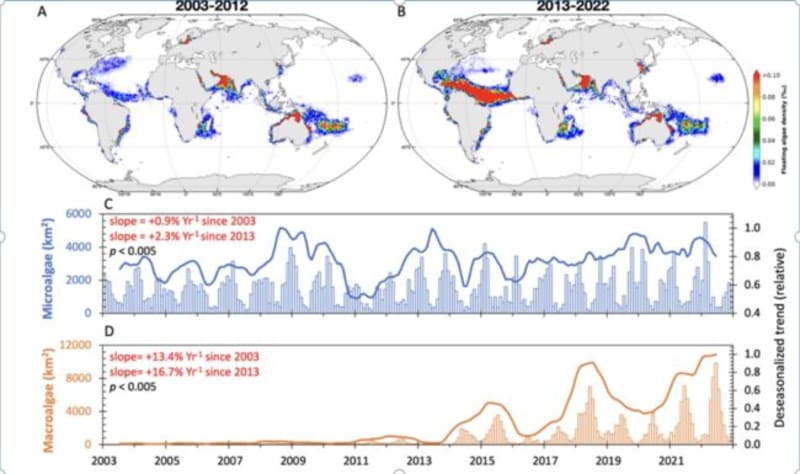
Scientists from the University of South Florida, NOAA, and Columbia University used artificial intelligence to analyze 1.2 million satellite images spanning two decades. What they found surprised them: both tiny microalgae and large seaweed patches have been growing steadily since around 2010, with some regions seeing three times more algae than before.
The computer model took months to train, scanning for subtle signs of algae floating on the ocean surface. Large seaweed blooms increased by 13.4 percent every year in the tropical Atlantic and western Pacific. In the Indian Ocean, floating algae tripled in just over a decade.
"With machine learning, we developed maps that clearly showed floating algae on the ocean was on the rise," says Joaquim Goes, a research professor at Columbia's Lamont-Doherty Earth Observatory. "While regional studies have been published, our paper gives the first global picture."
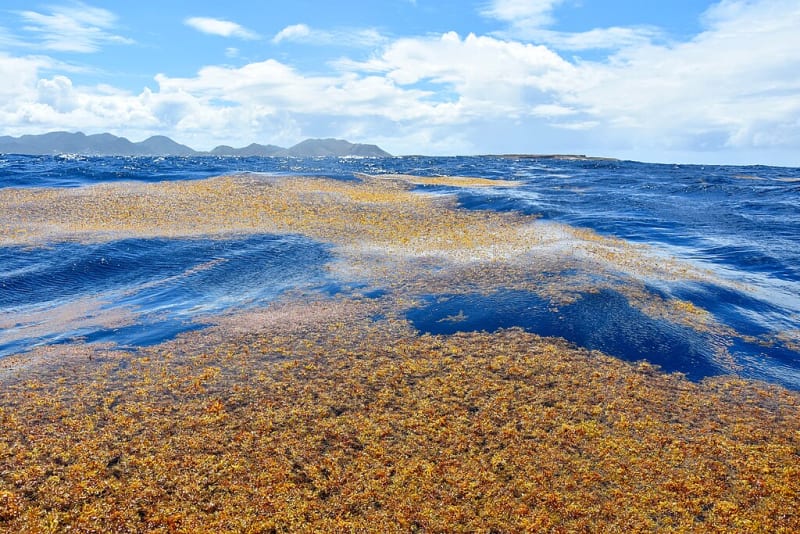
Before 2008, major seaweed blooms were rare outside the Sargasso Sea. Then something shifted: a massive green seaweed bloom appeared in the Yellow Sea in 2008, followed by a brown Sargassum bloom in the tropical Atlantic in 2011. The ocean was changing faster than anyone expected.
Why This Inspires
This discovery represents more than just tracking algae. It shows how artificial intelligence can help us understand and protect our oceans in ways impossible just years ago.
The same technology that spotted these changes can now help coastal communities prepare for incoming blooms. Fishermen can use the data to find better fishing grounds, since floating seaweed creates nurseries for many fish species. Scientists can track which regions need protection from the harmful effects of too much algae washing ashore.
The research team processed their enormous dataset thanks to high-performance computing facilities that analyzed multiple satellite images simultaneously. Even with powerful computers, the analysis took several months. Without AI, it would have taken decades or been impossible.
Understanding why algae is increasing gives us power to respond. The blooms likely result from warming oceans, changing currents, and nutrient pollution from farms and cities. Some of these causes we can address through better environmental policies.
"On a global scale, we appear to be witnessing a regime shift from a macroalgae-poor ocean to a macroalgae-rich ocean," says Chuanmin Hu, the study's senior author and oceanography professor at USF.
The research team isn't stopping here. They're already exploring additional satellite data to better understand these ocean-wide changes and help communities adapt.
In open water, floating seaweed provides homes for fish, turtles, and countless other species. With better monitoring and understanding, we can help maximize these benefits while protecting coastlines from harmful blooms. This global view of our oceans is just the beginning of smarter ocean stewardship.
More Images
Based on reporting by Google News - Scientists Discover
This story was written by BrightWire based on verified news reports.
Spread the positivity!
Share this good news with someone who needs it