AI Robots Learn to Navigate Homes They've Never Seen
A 31-year-old researcher has taught robots to handle completely new environments without trial-and-error training. His breakthrough could finally bring helpful robots into our homes.
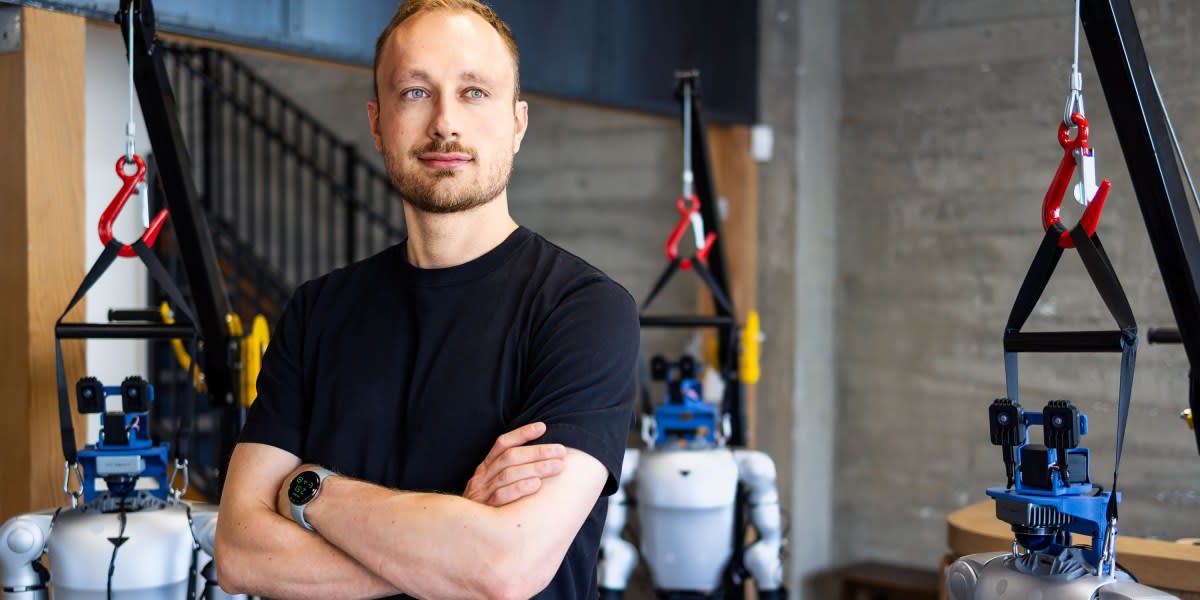
Danijar Hafner's San Francisco office is nearly empty except for one thing: humanoid robots hanging like marionettes from ceiling racks. The 31-year-old entrepreneur is teaching them something remarkable: how to walk into a stranger's home and navigate it perfectly on the first try.
Traditional robots need extensive real-world practice to learn new tasks. Hafner's approach skips that entirely using something called model-based reinforcement learning.
Here's how it works: He creates digital world models that mimic physical reality. AI agents train inside these virtual environments, essentially playing in hyper-realistic simulations. They learn to predict outcomes and plan ahead, then apply those skills in the real world when they encounter brand-new situations.
Hafner started small, proving his concept through video games. His PlaNet model let AI agents plan ahead. Dreamer 2 reached human-level performance on classic Atari games. Dreamer 3 became the first AI to mine diamonds in Minecraft without help.
Dreamer 4 went even further, learning to play Minecraft by watching gameplay videos without ever touching the actual game. Think of it like learning to ride a bike by watching YouTube, then hopping on and pedaling away perfectly.
His former manager at Google DeepMind, Timothy Lillicrap, says Hafner sits in the top half of 1% of researchers at the company. "In many cases he would build, single-handedly, things it would take entire teams of engineers to build," Lillicrap explains.
Hafner's journey started in rural northeastern Germany, where his parents were classical musicians. A neighbor taught him programming, and online AI courses in high school sparked a passion for understanding how thinking works.
Why This Inspires
This technology solves one of robotics' biggest challenges: the messy unpredictability of real life. Every home has different furniture layouts, pets that might wander by, and toys left on the floor. Training robots for every possible scenario would be impossible.
Hafner's world models let robots develop general intelligence about how physical spaces work. His DayDreamer project already demonstrated robots reacting to being pushed over without any specific training for that situation.
Now leading his own stealth-mode startup, Hafner is tight-lipped about specifics but hints at big ambitions: "I was interested in solving a problem that would change the world."
The humanoids in his office represent that future, one where helpful robots can enter any environment and immediately understand how to assist without months of programming and testing.
Based on reporting by MIT Technology Review
This story was written by BrightWire based on verified news reports.
Spread the positivity!
Share this good news with someone who needs it