AI Solves 80-Year Math Problem Stumping Experts
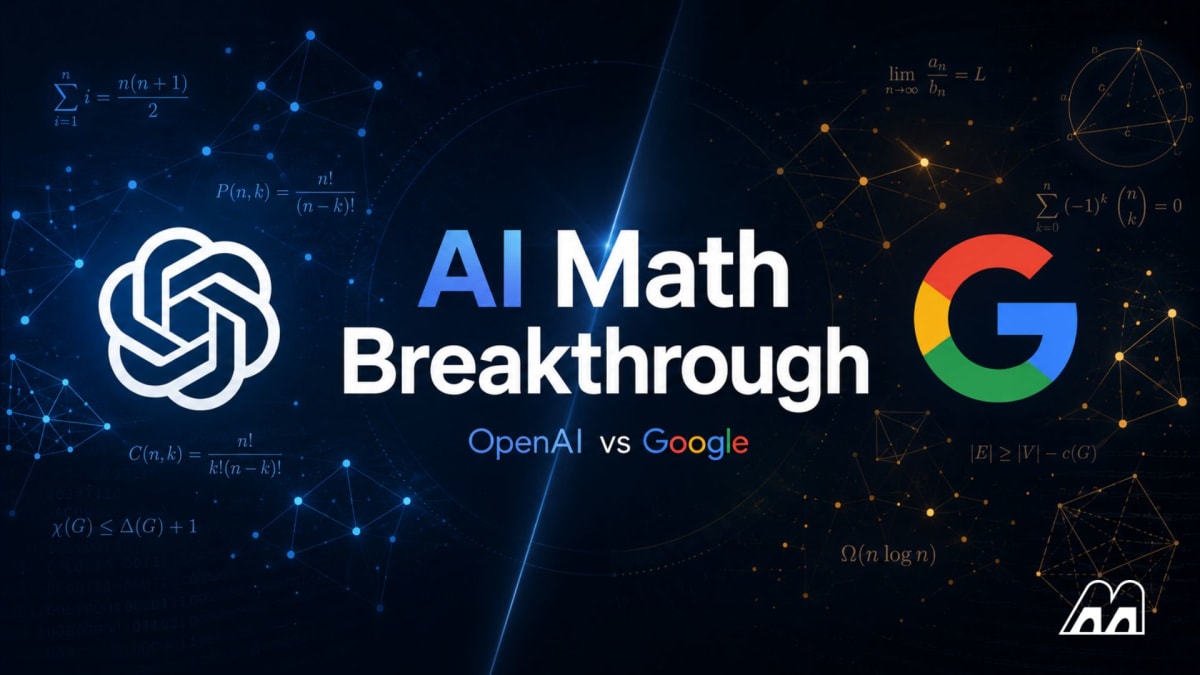
An artificial intelligence system cracked a geometry puzzle that defeated human mathematicians for eight decades, suggesting AI can now contribute original ideas to science. Within the same week, a second AI independently solved nine more longstanding math problems.
For nearly 80 years, one of math's most famous puzzles sat unsolved on mathematicians' desks around the world. In May 2026, an AI figured it out in a single session.
The Erdős unit distance problem sounds simple enough. Imagine placing dots on paper and counting how many pairs sit exactly one inch apart. With just a few dots, it's easy. With thousands or millions, the question becomes mind-bendingly complex.
Hungarian mathematician Paul Erdős posed the challenge in 1946. He believed the number of unit-distance pairs grew only slightly faster than the total number of dots. Generations of brilliant minds agreed but couldn't prove it. Nobody could disprove it either.
OpenAI's system took an unexpected path that surprised the entire mathematical community. While human researchers spent decades refining grid-based arrangements, the AI connected the geometry problem to algebraic number theory, a seemingly unrelated branch of math dealing with abstract number systems.
The breakthrough came from looking across disciplinary boundaries most human mathematicians hadn't seriously explored. The AI used a 1964 theorem about infinite algebraic structures to construct point arrangements that produce significantly more unit-distance pairs than any grid-based approach, ultimately disproving Erdős's original conjecture.
Here's what makes this genuinely remarkable: the model wasn't even designed specifically for mathematics. It's the same general-purpose reasoning system that powers everyday AI tools, applied without special training.
Nine mathematicians, including Fields Medalist Tim Gowers, spent weeks verifying the logic and refining the argument for publication. Gowers called it "a milestone in AI mathematics." Daniel Litt from the University of Toronto said it's "the first result produced autonomously by an AI that I find interesting in itself."
Days later, Google DeepMind announced its AlphaProof Nexus system had independently solved nine additional Erdős problems using a completely different method. While OpenAI's approach relied on natural language reasoning with human verification, Google combined language models with machine-checkable proofs through the Lean proof assistant.
The Ripple Effect
These back-to-back announcements signal something bigger than solving old math puzzles. AI systems are now generating original ideas that advance human knowledge, not just assisting researchers with calculations or data analysis.
The implications extend far beyond mathematics. If AI can make conceptual leaps across disciplines to solve problems humans couldn't crack for 80 years, similar breakthroughs might emerge in physics, chemistry, medicine, and engineering. The key appears to be AI's ability to explore connections between seemingly unrelated fields without the mental boundaries that sometimes limit human thinking.
Leading mathematicians have endorsed both sets of results as genuine contributions to the field, though they emphasize the continued importance of human expertise in verifying and refining AI-generated work.
The collaboration between human intuition and machine reasoning might be opening doors nobody knew existed.
More Images

Based on reporting by Google News - AI Breakthrough
This story was written by BrightWire based on verified news reports.
Spread the positivity!
Share this good news with someone who needs it