AI Speeds Science 1,000x, But Humans Still Lead
Artificial intelligence is revolutionizing scientific discovery across every field, from designing new viruses that fight bacteria to simulating 1,000 years of climate in a single day. But researchers at Stanford agree: AI finds answers faster, while humans still choose which questions matter most.
📺 Watch the full story above
Scientists just gained a superpower that's transforming research as dramatically as the invention of the telescope. At Stanford's AI+Science conference in May 2026, researchers revealed how artificial intelligence is opening entirely new possibilities across every field of science.
The numbers are staggering. A new AI model called Samudra can predict ocean states 1,000 times faster than traditional methods, simulating 1,000 years of climate per day on a single computer. The old approach? Just 12 years per day.
In biology, Stanford professor Brian Hie showed how an AI called EVO designed 16 previously unknown viruses that kill harmful bacteria. These aren't just predictions on paper. When researchers actually created them in the lab, they worked.
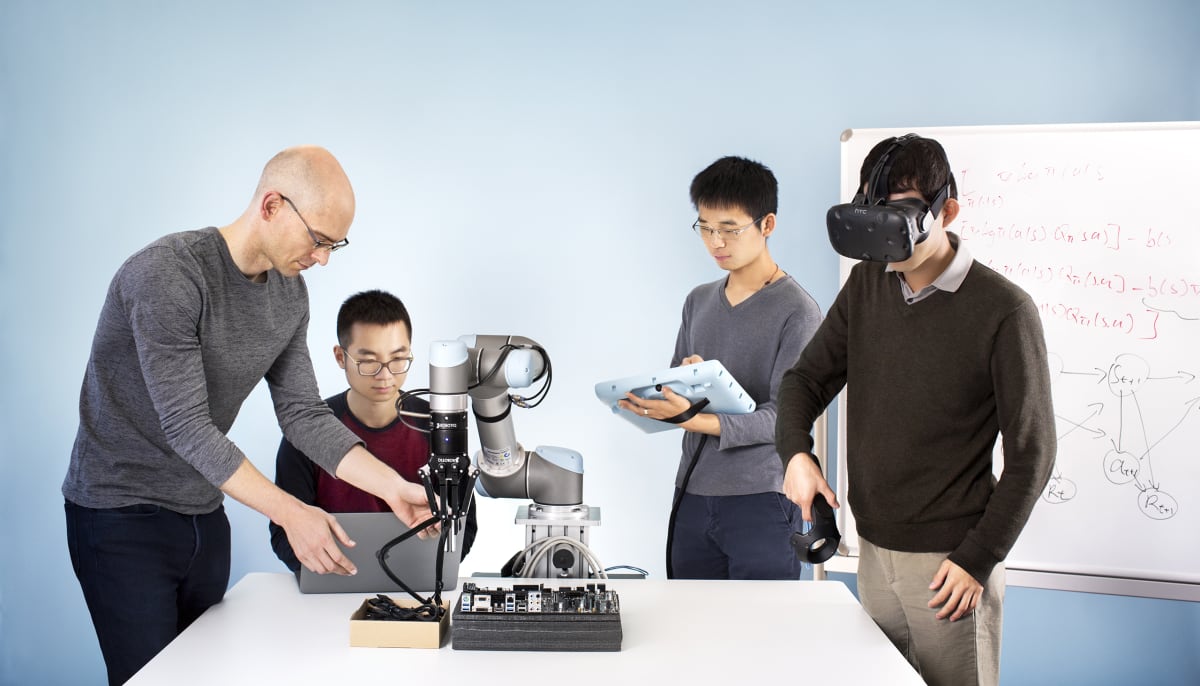
Even more remarkable, Stanford professor James Zou built a Virtual Lab where AI agents act like scientists. They generate their own hypotheses, design experiments, and hold group meetings to solve problems. When Zou asked them to design antibodies for new COVID variants, they delivered results in days that proved better than previous human designs.
Neuroscientists are building digital twins of the brain to run millions of virtual experiences. Mathematicians are using AI to crack long-standing puzzles in number theory. The pace of discovery is accelerating across every discipline.
But here's where the story gets even better. Despite AI's incredible power, the scientists at Stanford emphasized that human judgment remains absolutely central to progress.
"AI changes what problems are tractable, but it doesn't tell us what problems matter," explained astrophysicist Risa Wechsler, who co-organized the conference. "What problems matter and what they mean to us are really a human endeavor."
The Bright Side
This partnership between human creativity and AI capability is creating something neither could achieve alone. AI excels at deductive science, finding patterns in massive datasets that human minds can't grasp. But humans perform what researchers call abductive science, making creative leaps when something surprising appears.
University of Chicago professor James Evens noted that when AI writes papers based only on predictable data, "they're boring papers." Human scientists bring the curiosity, the moral reasoning, and the ability to ask why something matters.
Stanford professor Angèle Christin called scientific research "craftsmanship" that requires years of learning to interpret results properly. Biology professor Anshul Kundaje added that because real-world data is messy and biased, human understanding remains essential for debugging both models and experiments.
The scientists described a future where AI acts as an autonomous collaborator, handling the computational heavy lifting while humans direct the questions, interpret meaning, and ensure discoveries serve humanity's best interests.
Stanford neuroscientist Surya Ganguli captured the mutual benefit perfectly: "AI will enable new scientific discoveries, but also the rigor demanded of scientific applications will drive the development of better AI."
The telescope let us see farther; AI helps us understand faster, but human wisdom still guides where we look and why.
Based on reporting by Google: scientific discovery
This story was written by BrightWire based on verified news reports.
Spread the positivity!
Share this good news with someone who needs it