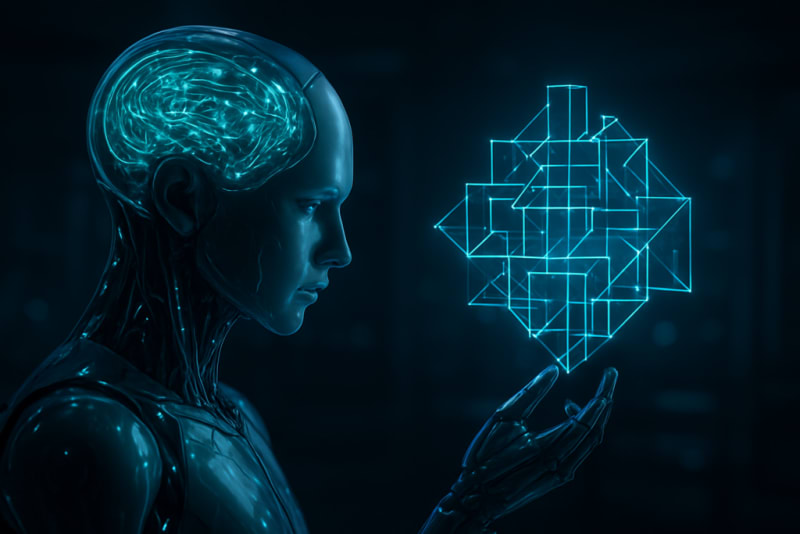
AI That Talks to Itself Learns 45% Faster With Less Data
Scientists in Japan created an AI that "mumbles" to itself like humans do when thinking through problems, slashing training time and errors. The breakthrough could make smart robots cheaper and more practical for everyday use.
Imagine teaching a student who thinks out loud versus one who stays silent. The first learns faster, makes fewer mistakes, and tackles new problems better. Scientists just proved the same is true for artificial intelligence.
Researchers at the Okinawa Institute of Science and Technology in Japan developed an AI system that talks to itself while solving problems. This "self-mumbling" process mirrors how humans use inner speech to work through challenges, and the results are stunning.
The mumbling AI achieved a 92% self-correction rate, meaning it caught and fixed its own mistakes before making them. It also needed 45% less training data than traditional AI models, proving that thinking out loud makes learning more efficient. When faced with brand new tasks it had never seen before, the system talked its way through the logic successfully.
Dr. Jeffrey Frederic Queißer and Professor Jun Tani led the research team that published their findings in Neural Computation in early 2026. Their approach differs dramatically from how companies like Google and OpenAI build AI systems today.
Instead of feeding machines massive amounts of data and hoping they spot patterns, the OIST team gave their AI a working memory and forced it to generate internal thoughts before taking action. This mental rehearsal space lets the AI reconsider its logic, reorder information, and plan ahead.
The system separates what it needs to do from how to do it, preventing the confusion that causes traditional AI to fail when switching between different tasks. By creating what researchers call "mumbling targets," the AI essentially practices in its head before committing to an answer.
The Ripple Effect
This breakthrough arrives at a perfect moment. Current AI models require enormous computing power and energy, making them expensive and environmentally costly. An AI that learns efficiently could run on smaller, cheaper devices rather than giant data centers.
Robot manufacturers are already taking notice. Google's robotics division is exploring how mumbling AI could help machines translate instructions into physical movements. A robot that can simulate outcomes mentally before moving could work safely in unpredictable environments like farms or warehouses.
The research also bridges a fascinating gap between human and machine intelligence. Psychologist Lev Vygotsky observed that children use private speech to master complex tasks. By mimicking this developmental milestone, scientists have created AI that learns more like we do.
Startups specializing in this reasoning-focused approach reportedly outperform traditional models while using a fraction of the computing power. If AI can think effectively on local hardware, the future might belong to smart devices in our homes and workplaces rather than distant server farms.
The shift from brute-force learning to efficient reasoning represents what researchers call moving from a "Scaling Era" to a "Reasoning Era." Progress through smarter thinking instead of just bigger machines offers a more sustainable path forward for artificial intelligence.
More Images



Based on reporting by Google News - AI Breakthrough
This story was written by BrightWire based on verified news reports.
Spread the positivity!
Share this good news with someone who needs it