Ancient Arctic Explorers Crossed Icy Seas 4,500 Years Ago
New archaeological evidence reveals that Paleo-Inuit people repeatedly braved a dangerous 33-mile ocean crossing to reach remote Greenland islands nearly 4,500 years ago. Their advanced seafaring skills and determination to reach vital food sources showcase remarkable human ingenuity in one of Earth's harshest environments.
Imagine crossing 33 miles of freezing Arctic ocean in a boat made of wood and animal skins, battling crosswinds and fog for 12 hours straight. That's exactly what ancient Arctic people did nearly 4,500 years ago, and they did it over and over again.
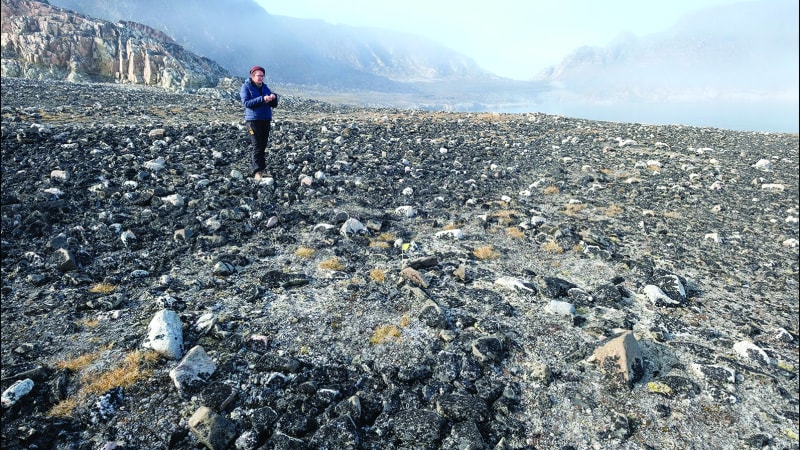
Archaeologists surveying remote islands off Greenland's northwest coast just discovered nearly 300 ancient features, including 15 prehistoric tent dwellings on Isbjørne Island. The findings prove that Paleo-Inuit people didn't just stumble upon these islands by accident. They intentionally made the treacherous journey multiple times.
The destination was worth the risk. The Kitsissut island cluster sits in the middle of a polynya, a rare pocket of open water surrounded by sea ice that teems with marine life. Contemporary Inuit communities told researchers that these islands were prime spots for hunting seabirds and gathering eggs, which sparked the archaeological investigation.
Lead researcher Matthew Walls from the University of Calgary says this concentration of tent rings is "one of the largest" in the region. Each dwelling is marked by a stone ring that once anchored a tent, with a hearth at the center. The team dated one site using animal bones found inside a tent ring, placing the occupation between 4,000 and 4,475 years ago.
Why This Inspires
These ancient adventurers had no GPS, no weather forecasts, and no rescue helicopters. They crossed dangerous waters in handmade boats during the brief Arctic summer to reach thick-billed murre nesting cliffs. The dwellings sit directly below where thousands of these seabirds still nest today, and murre bones scatter the sites.
The journey required extraordinary skill and courage. The open-sea route features erratic crosswinds, dense fog, and powerful mixing currents. Yet these early Arctic people mastered watercraft technology and seafaring techniques advanced enough to make this 12-hour crossing safely, again and again.
Their determination to reach these islands shows how humans have always found ways to thrive in Earth's most challenging environments. They didn't just survive the Arctic. They explored it, mapped its resources, and built lives around its rhythms.
These remote stone circles tell a story of human resilience that still resonates 4,500 years later.
More Images




Based on reporting by Live Science
This story was written by BrightWire based on verified news reports.
Spread the positivity!
Share this good news with someone who needs it