Ancient Lighthouse Blocks Rise From Sea After 1,000 Years
Twenty-two massive granite blocks from the legendary Lighthouse of Alexandria have been lifted from the Mediterranean seafloor, giving scientists their first chance to understand how one of the Seven Wonders of the Ancient World was built. Researchers are now digitally reconstructing the monument block by block, creating a 3D model that could one day project a hologram of the lighthouse over Alexandria's harbor.
After sleeping beneath the Mediterranean for a thousand years, pieces of one of humanity's greatest architectural achievements are finally revealing their secrets.
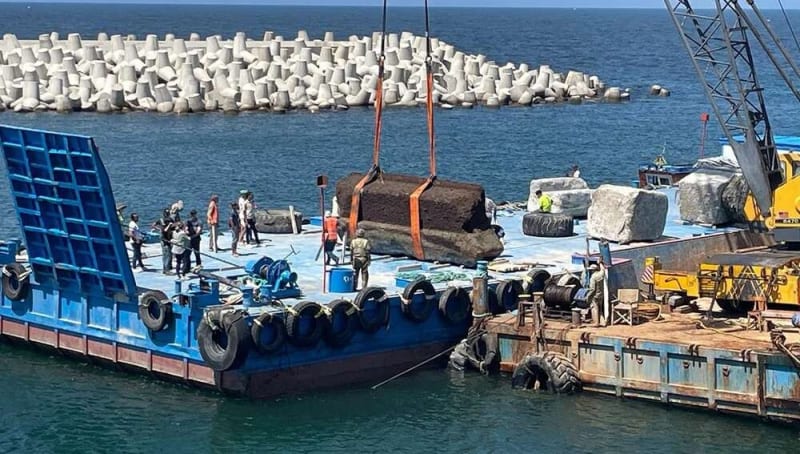
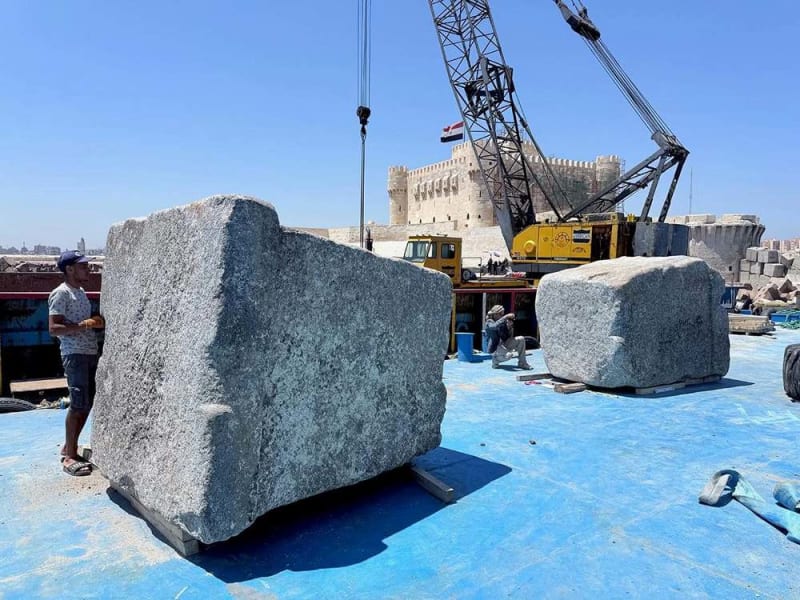
French and Egyptian researchers have recovered 22 massive granite blocks from the ancient Lighthouse of Alexandria, each weighing dozens of tons. The blocks once formed the entrance to the towering structure, including upright pillars, frames, and crossbeams that welcomed sailors home for centuries.
The lighthouse earned its place among the Seven Wonders of the Ancient World for good reason. Built around 280 BCE under Ptolemy, one of Alexander the Great's generals who declared himself ruler of Egypt, the structure guided ships safely into Alexandria's harbor for over a millennium. It took multiple earthquakes across several centuries to finally topple it into the sea, with the final collapse occurring in the 10th century.
For over a decade, France's National Center for Scientific Research and Egypt's Center for the Studies of Alexandria have been mapping the underwater ruins. A landmark 2014 survey identified 3,000 blocks and 5,000 stone pieces scattered across a four-acre seabed area.
The recovery process required meticulous care. Every raised block was photographed from all angles and fed into a photogrammetry database, creating precise 3D models that captured every chip, tool mark, and edge. This allowed researchers to study the stones in perfect detail without keeping them out of the water.
Led by archaeologist Isabelle Hairy, the team is now playing the ultimate puzzle game. Using sophisticated digital modeling software, they can test how blocks fit together with a mouse click instead of a crane. When two pieces seem to match, they can even simulate earthquake patterns to understand how the lighthouse fell.
Why This Inspires
The blocks themselves tell a story of cultural fusion. Some bear Egyptian imagery carved with Greek techniques, capturing the blend of civilizations under Ptolemaic rule. Other granite monoliths appear to come from Old Kingdom sites at Abu Rawash, meaning they were already 2,000 years old when the lighthouse was built.
A Moorish pilgrim named Ibn Jubayir once tried describing the lighthouse but struggled to find adequate words. He measured one side at over fifty arm lengths and estimated the height at more than 150. Inside, he found a maze of stairways, entrances, and apartments so vast that visitors could get lost exploring its passages.
Egyptian authorities won't permit permanent recovery of blocks over 220 pounds. After centuries in salt water, exposure to oxygen would cause salt crystals to grow in cracks and crevices, destroying the ancient stones. So after photographing, the largest pieces return to their watery resting place.
The 3D reconstruction opens exciting possibilities for the future. Researchers suggest their precise digital model could support novel ways of presenting the monument to visitors. In another decade, a holographic projection might rise above Alexandria's harbor, resurrecting the lighthouse in light just as it once guided sailors home with fire.
One of humanity's lost wonders is being remembered, one stone at a time.
More Images
Based on reporting by Good News Network
This story was written by BrightWire based on verified news reports.
Spread the positivity!
Share this good news with someone who needs it