Ancient Maya Adapted to Climate Change in Hidden Wetlands
Archaeologists in Belize uncovered remarkably preserved wooden structures showing how Maya communities thrived in wetlands after droughts forced them to abandon cities. The discovery rewrites what we thought possible in tropical archaeology.
Buried beneath a wetland in northwestern Belize, archaeologists found something that shouldn't exist: 700-year-old wooden buildings still standing in a tropical swamp.
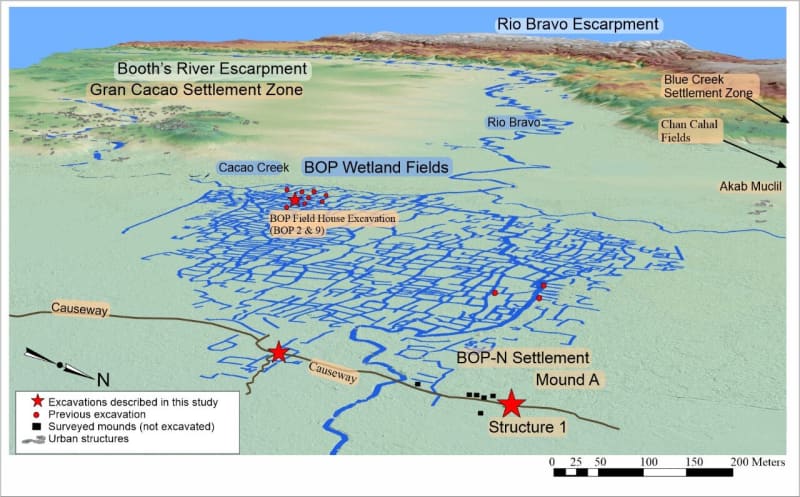
The discovery at the Birds of Paradise site reveals how Maya people didn't just survive climate upheaval between 800 and 1500 AD. They adapted by building entire communities in wetlands after nearby cities collapsed.
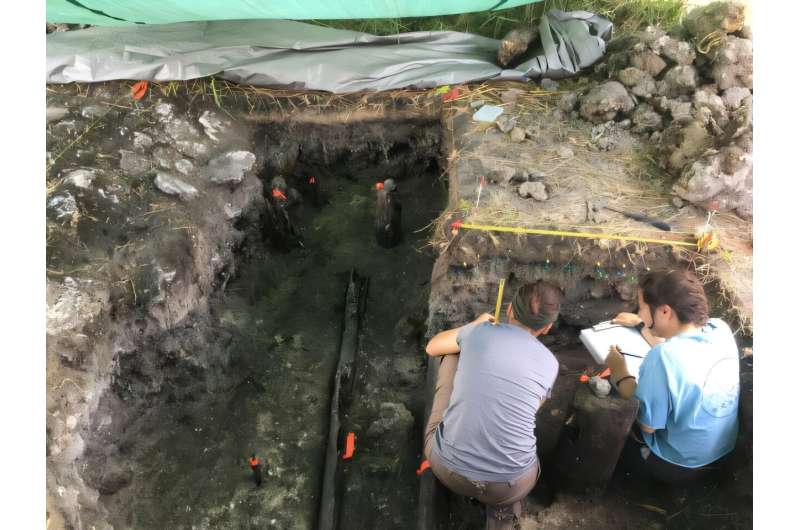
Dr. Lara Sánchez-Morales from New York University led the team that uncovered 10 wooden posts, eight earthen mounds, and a large limestone platform. It's the largest collection of architectural wood ever found inland in the Maya region, preserved in conditions scientists thought impossible for organic materials.
The team used laser mapping technology to scan the landscape, but the real breakthrough came from careful excavation. Layer by layer, they reconstructed how the settlement grew and changed over centuries.
What makes this find special isn't just the preservation. The artifacts scattered throughout the site paint a picture of resourceful people who refused to give up when their world changed.
Ceramics, stone tools, and animal remains show these wetland dwellers hunted, fished, and built using whatever materials they could find. When drought made city life impossible, they moved to where water was guaranteed.
Why This Inspires
This discovery challenges a fundamental assumption in archaeology: that tropical wetlands couldn't preserve ancient settlements. For decades, researchers may have walked past similar sites, never imagining what lay beneath.
The Maya communities demonstrated something timeless about human resilience. When climate extremes disrupted their established way of life, they didn't disappear. They found new places to call home and new ways to thrive.
Dr. Timothy Beach from the University of Texas notes the team still has questions about how large these wetland populations grew and how they functioned. Future excavations will explore how Maya builders selected rare woods and how entire communities fed themselves in these refuge environments.
The research, published in the Proceedings of the National Academy of Sciences after 20 years of fieldwork, suggests countless similar settlements might still be waiting for discovery across the American tropics.
Ancient ingenuity reminds us that adaptation has always been part of the human story.
More Images

Based on reporting by Phys.org
This story was written by BrightWire based on verified news reports.
Spread the positivity!
Share this good news with someone who needs it