Ancient Ocean Chemistry Solved 570M-Year-Old Fossil Mystery
Scientists cracked the puzzle of how delicate, soft-bodied creatures from 570 million years ago survived as fossils in sandstone where preservation should be impossible. Ancient ocean chemistry created natural clay "cement" that locked their shapes into rock, revealing a crucial chapter in how complex life emerged on Earth.
For decades, scientists have puzzled over Earth's strangest fossils: jellyfish-like creatures preserved in perfect detail where nothing soft-bodied should survive. Now researchers at Yale University have finally solved the mystery, and the answer reveals a pivotal moment when life on Earth was getting ready to explode into the complex forms we know today.
The Ediacara Biota lived 570 million years ago, and they look nothing like modern animals. Some have three-way symmetry, others sport spiraling arms or fractal patterns that make them hard to place on any family tree.
These bizarre organisms faced a preservation problem. Soft creatures like jellyfish almost never become fossils because their bodies decay too quickly. Sandstone makes it even harder since its coarse grains let water wash through, typically erasing delicate remains long before they can fossilize.
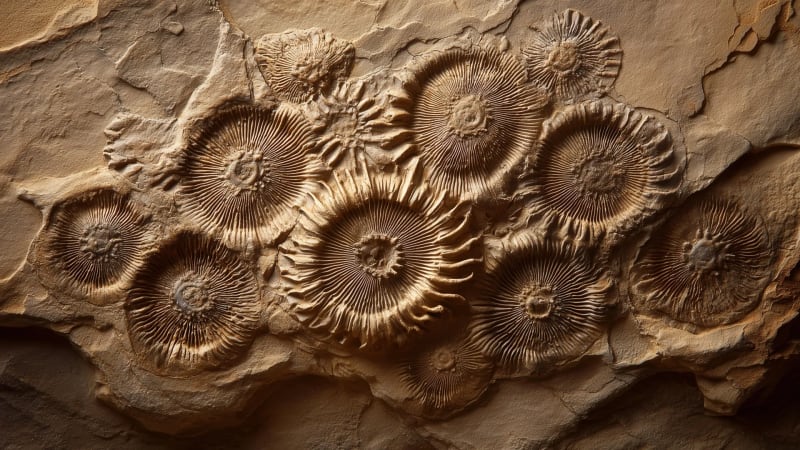
Yet thousands of these fragile creatures were buried by sand and preserved with stunning precision, leaving detailed impressions that have baffled paleontologists worldwide. Understanding how they survived in rock is key to understanding a major missing chapter in the history of visible life on Earth.
Dr. Lidya Tarhan and her team used an innovative approach to crack the case. They analyzed lithium isotopes in Ediacara fossils from Newfoundland and northwest Canada, tracing the chemical fingerprints of different types of clay minerals.
The results revealed something remarkable about ancient oceans. When sand buried these creatures, clay particles already in the sediment provided surfaces where new clays could form directly within the seafloor. Fed by silica-rich and iron-rich seawater unique to that time period, these new clays grew around the buried organisms like natural cement, binding sand grains together and capturing every delicate detail.
This discovery overturns a long-held belief. Scientists previously thought these organisms had unusually tough or chemically resistant bodies that helped them fossilize. Instead, their preservation depended entirely on the special chemistry of ancient seawater and sediments.
Why This Inspires
These organisms lived just tens of millions of years before the Cambrian Explosion, when complex animal life rapidly diversified starting 540 million years ago. For years, that event seemed like a sudden breakthrough, but scientists now see it as the culmination of a much longer buildup.
Tarhan calls this process a "long fuse," with the Ediacara Biota representing an important early phase. Understanding how they were preserved helps scientists gauge whether these fossils provide a faithful reflection of ancient seafloor life, which matters for piecing together how complexity and diversity first emerged in the animal kingdom.
The team plans to apply the same lithium isotope method to fossils from other regions and time periods. Their work offers a clearer window into Earth at a crucial turning point, showing how the right environmental conditions at the right moment preserved evidence of life's grand experiment with new forms and possibilities.
Sometimes the most important scientific breakthroughs come from understanding not just what lived long ago, but how the Earth itself helped their stories survive to inspire us today.
Based on reporting by Google: fossil discovery
This story was written by BrightWire based on verified news reports.
Spread the positivity!
Share this good news with someone who needs it