Ancient Star Mira Surprises Stargazers Every 332 Days
A star that vanishes and reappears has been delighting astronomers for over 400 years. Right now, Mira is putting on one of its brightest shows, visible to the naked eye through February.
Imagine looking up at the night sky and seeing a star appear out of nowhere, bright enough to rival the North Star, then watching it slowly fade into invisibility over the next few months.
That's exactly what happens with Mira, a remarkable star that's been surprising humans since 1596. German astronomer David Fabricius thought he'd discovered something completely new when he spotted the bright star while tracking Jupiter. When it vanished weeks later, he assumed it was gone forever.
Twelve years later, Fabricius nearly fell out of his chair when the star reappeared in the exact same spot. He called it a "wonderful thing" in a letter to fellow scientist Johannes Kepler, and the excitement in his words still jumps off the page centuries later.
Polish astronomer Johannes Hevelius eventually named it Mira, meaning "wonderful" or "astonishing" in Latin. The name couldn't be more perfect for a star that literally beats like a heart in the sky.
Mira doesn't just twinkle. It physically swells and shrinks over 332 days, brightening as it contracts and heating up, then cooling and dimming as it expands. At its brightest, it reaches magnitude 2, easily visible to anyone looking up. At its faintest, it drops to magnitude 10, requiring a telescope to see.
What makes this celestial show possible is an epic battle happening inside the star. Gravity pulls inward while the pressure from fusing hydrogen and helium pushes outward. The star compresses, heats up, then explodes outward again in an endless cosmic dance.
Why This Inspires
Mira represents something rare in our fast-paced world: a natural wonder that rewards patience. You can't stream it on demand or speed it up. You simply have to wait and watch.
Amateur astronomers have been tracking Mira's cycles for generations through the American Association of Variable Star Observers. Anyone with clear skies can join in, estimating its brightness and adding their observations to centuries of data.
Right now, Mira is approaching peak brightness, expected around February 7th. On Christmas Eve 2024, it shone at magnitude 5.0. By early January, it had jumped to magnitude 3.6, bright enough to spot in moderately dark skies.
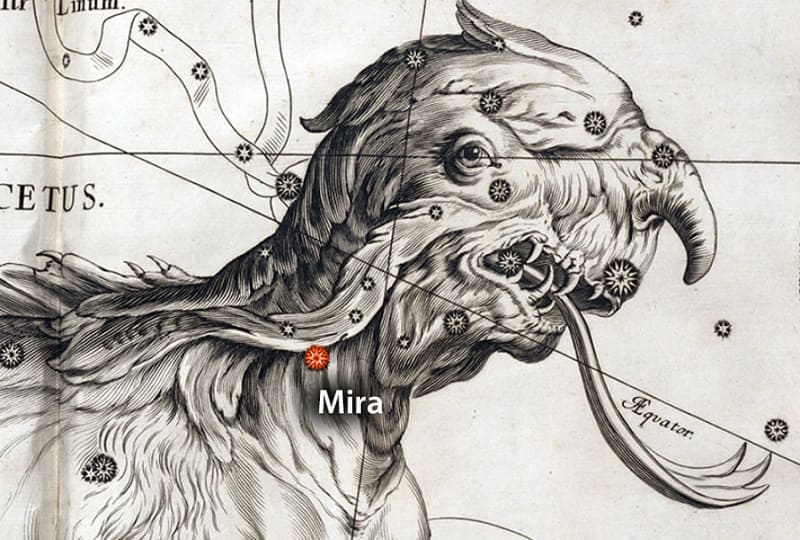
The star lives in the constellation Cetus, the Sea Monster, standing nearly due south after twilight. You can find it by locating the Pleiades cluster and Aldebaran, then looking southwest toward Menkar, the brightest star in Cetus. Mira sits about 13 degrees beyond that.
For centuries, this pulsating red giant has reminded us that the universe still holds surprises. Even in our age of space telescopes and planetary rovers, a star discovered in the Renaissance can still make us look up in wonder.
Mira proves that some of the best shows in the universe are free, require no equipment beyond your own eyes, and have been running for billions of years.
More Images


Based on reporting by Sky & Telescope
This story was written by BrightWire based on verified news reports.
Spread the positivity!
Share this good news with someone who needs it