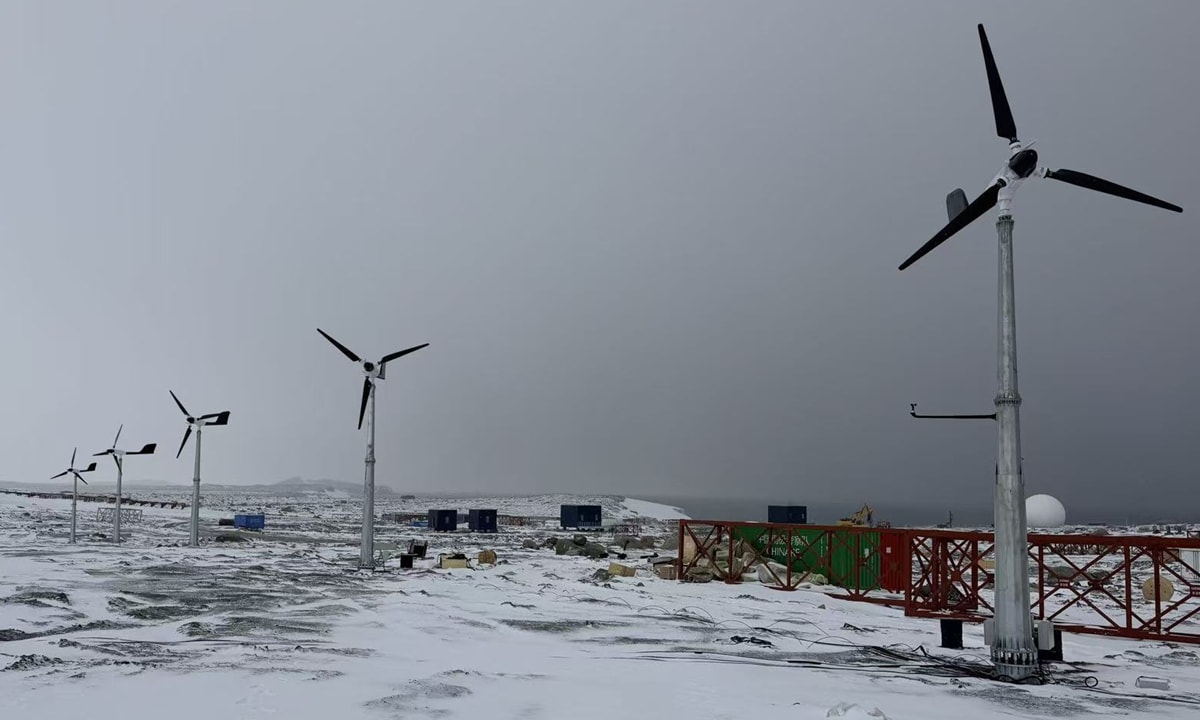
Antarctica Station Runs 50% on Renewables During Polar Night
China's newest Antarctic research station is achieving something remarkable in one of Earth's harshest environments: powering half its operations with renewable energy even during months of total darkness. The breakthrough shows clean energy can work anywhere, even at the bottom of the world.
Imagine keeping the lights on during a winter night that lasts four months straight, using nothing but wind and stored hydrogen power.
That's exactly what's happening at China's Qinling Station in Antarctica, where researchers are proving that renewable energy can thrive even in Earth's most extreme conditions. Station director Wang Tao announced this week that clean energy now provides around 50 percent of the station's electricity during the polar night, when the sun doesn't rise for months.
The station, located on Inexpressible Island in the Ross Sea region, uses an innovative wind-solar-hydrogen-storage system that works like a carefully choreographed energy dance. During Antarctica's summer, when the sun never sets, solar panels generate more than 60 percent of the station's power needs. The system captures excess energy and converts it into hydrogen fuel, storing it like a battery for the dark winter months ahead.
When polar night arrives and temperatures plummet, wind turbines and stored hydrogen keep the station running alongside backup diesel generators. The multi-source approach ensures researchers never lose power, even when conditions turn brutal.
The results go far beyond impressive statistics. The renewable system saves at least 200 tons of diesel fuel every year, fuel that would otherwise need to be shipped over 10,000 kilometers from China through some of the world's most dangerous waters. That means fewer supply runs, lower carbon emissions, and reduced risk for transport crews.
The Ripple Effect
What happens in Antarctica doesn't stay in Antarctica. The technology being tested at Qinling Station could transform how remote research facilities and isolated communities worldwide approach energy independence.
Wang explained that the station builds on lessons learned from China's earlier Taishan Station, which tested simpler wind and solar systems. Over the past decade, rapid advances in renewable technology made it possible to create the more sophisticated system now running at Qinling. The success proves that clean energy solutions can scale up to meet the demands of year-round operations in the harshest climates imaginable.
Other nations with Antarctic operations are watching closely. If renewables can power a research station during months of darkness and subzero temperatures, the technology holds promise for remote communities across the Arctic, high mountain regions, and isolated islands struggling with expensive fuel deliveries.
The station officially began full operations in 2024, and Wang says the energy system is already serving as a potential model for future polar facilities. Each successful season of operation provides valuable data about how to optimize renewable systems in extreme cold, high winds, and complete darkness.
As climate research grows more urgent, having sustainable research stations in Antarctica means scientists can study environmental changes without contributing to the problem they're trying to solve.
Based on reporting by Google News - Renewable Energy Breakthrough
This story was written by BrightWire based on verified news reports.
Spread the positivity!
Share this good news with someone who needs it