Assam Family Raises Orphaned Civet, Now in School Textbooks
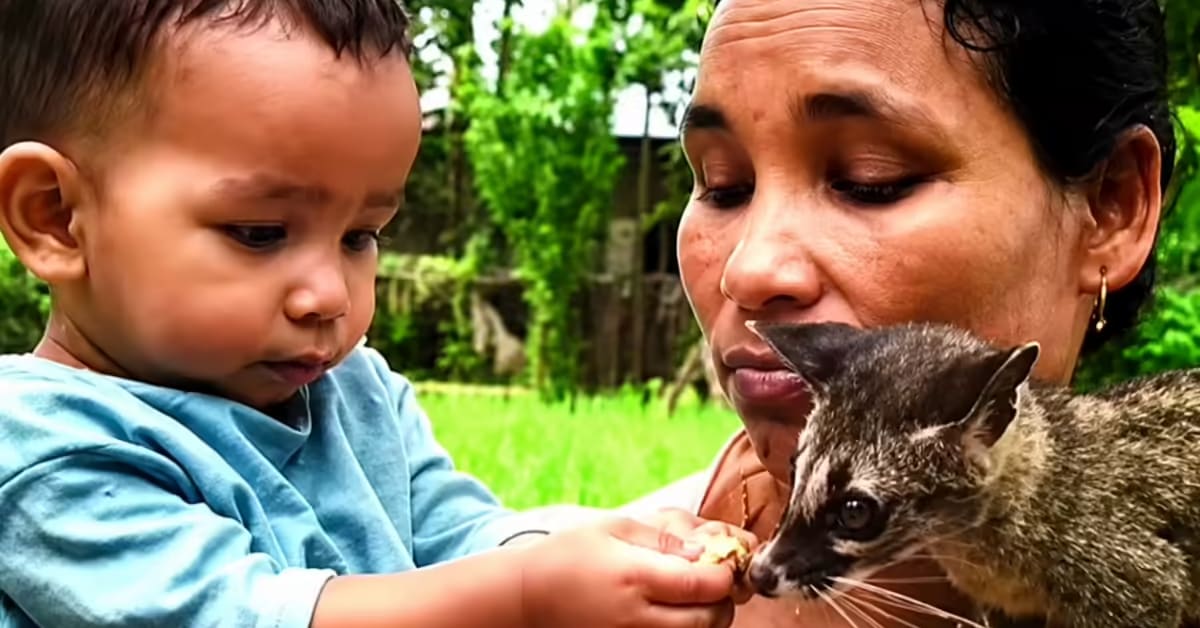
A teenage boy in Assam discovered his own baby photo in his Class 10 English textbook, nestled beside an orphaned palm civet his mother nursed alongside him. The story of Baby Bhakat has traveled from a small village rescue to millions of students across India.
Gibon was flipping through his Class 10 English textbook when he saw something strange. A baby lying beside a tiny palm civet in photos that looked oddly familiar.
The teenager from Kampur, Assam, didn't recognize himself at first. But the child in those images was him, and the story was his family's.
In 2009, when Gibon was just six months old, a two-week-old Asian palm civet fell from a tree in Tetelisora village. The cub, barely bigger than a hand, had no chance of surviving alone.
Villagers called Dharani Saikia, known locally as the "Forest Man" for rescuing injured wildlife. He brought the tiny animal home, but keeping it alive posed a challenge.
After consulting a rescue center, the family learned the cub needed mother's milk to survive. Anjali Saikia, already nursing baby Gibon, made an extraordinary choice: she would nurse the civet too.
They named him Bhakat. He became their third child.
For months, Bhakat lived as part of the family. He ate rice, fish, and meat at their table and slept in the same bed as the children.
As Gibon learned to crawl, Bhakat explored alongside him. One human, one wild, growing up like brothers.
Conservation photographer Rommel Shunmugan heard about the rescue and spent 10 days documenting their life together. After he left for Delhi, the family lost touch and assumed the photos had disappeared into an old file.
Then this year, Gibon came home from his board exams with surprising news. His English textbook featured a chapter called "Baby Bhakat."
Sunny's Take
The chapter has been part of India's NCERT curriculum since 2024, reaching millions of students nationwide. For Gibon, seeing his infant self beside Bhakat was like meeting a sibling he never knew he had.
For the people of Kampur, the inclusion has become a source of pride. A quiet act of compassion from a small Assam town now teaches children across the country about wildlife and empathy.
The story also challenges harmful myths about Asian palm civets. These shy, nocturnal mammals are called "gravediggers" in Delhi, "baby stealers" in Kolkata, and "onion thieves" in Maharashtra.
Wildlife experts say civets are actually beneficial. They disperse seeds, control rodent populations, and play important roles in their ecosystems.
But habitat loss pushes them into cities, where fear and misunderstanding often replace compassion. They're threatened by poaching for musk used in perfumes and killed as pests when they're simply homeless.
Bhakat's story offers a different narrative. It shows that when humans choose kindness over fear, even the smallest rescue can ripple outward in ways no one imagines.
A mother who chose to nurse a dying cub. A photographer who preserved that moment. A curriculum board that recognized a story worth sharing.
And now millions of students learning that compassion doesn't have borders between species.
More Images
%2Fenglish-betterindia%2Fmedia%2Fmedia_files%2F2026%2F07%2F14%2Fcivet-2026-07-14-14-43-24.png)
%2Fenglish-betterindia%2Fmedia%2Fmedia_files%2F2025%2F11%2F20%2Fwild-at-heart-banner-image-microsite-banner-2025-11-20-16-17-04.jpg)
%2Ffilters%3Aformat(webp)%2Fenglish-betterindia%2Fmedia%2Fmedia_files%2F2026%2F07%2F14%2Fcivet-1-2026-07-14-14-47-01.png)
Based on reporting by The Better India
This story was written by BrightWire based on verified news reports.
Spread the positivity!
Share this good news with someone who needs it