Astronomers Discover Metallic Winds in Mystery Cloud
Scientists captured the first-ever measurements of swirling metal winds inside a massive cloud orbiting an unknown object 3,000 light-years away. The breakthrough reveals how planetary systems continue evolving billions of years after formation.
📺 Watch the full story above
For nine months, astronomers watched something extraordinary happen in the night sky: a sun-like star suddenly dimmed to just a fraction of its normal brightness, obscured by a mysterious cloud sweeping through space.
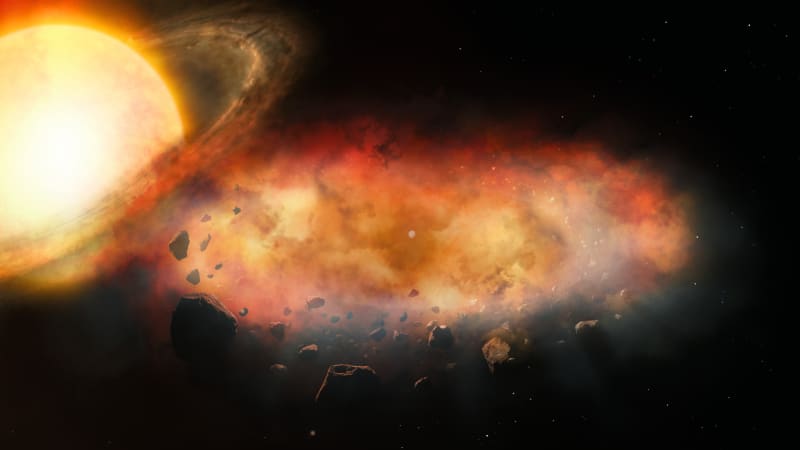
The culprit turned out to be far more fascinating than anyone expected. Using cutting-edge telescopes in Chile, scientists discovered the cloud contains winds of vaporized metals like iron and calcium, swirling around an unknown object in the outer reaches of a distant solar system.
"Stars like the sun don't just stop shining for no reason, so dramatic dimming events like this are very rare," says Nadia Zakamska, an astrophysics professor at Johns Hopkins University who led the research. Her team jumped at the rare opportunity to study the event from September 2024 through May 2025.
The observations revealed a cloud roughly 120 million miles across, hovering about 1.2 billion miles from its host star. Something massive enough to hold the cloud together orbits within it, but scientists can't yet tell if it's a giant planet, a brown dwarf, or a small star.
What makes this discovery truly groundbreaking is the detail. The Gemini High-resolution Optical SpecTrograph allowed researchers to measure how the metallic gases move in three dimensions for the first time ever in a system like this. Previous observations could only detect these clouds, not track their internal motion.
The data shows a chaotic, dynamic environment with winds of gaseous metals sweeping through the cloud. These measurements confirm the cloud moves independently from its host star, orbiting in the system's outer regions like a cosmic storm system circling a mysterious center.
Why This Inspires
This discovery reminds us that space never stops surprising us with new wonders to explore. Planetary systems we thought were settled and stable turn out to be dynamic, evolving environments still shaping themselves billions of years after birth.
The breakthrough also showcases what happens when scientists spot something unusual and have the tools ready to investigate. The rapid response to this rare dimming event, combined with brand-new telescope technology, opened a window into processes we've never witnessed before.
Every new measurement adds another piece to the puzzle of how solar systems form and change over time. Understanding these distant systems helps us grasp our own solar system's past and future, connecting us to the broader story of planets and stars across the universe.
Scientists continue monitoring the star for future dimming events, hoping the mysterious cloud will pass by again and reveal more secrets about what lies hidden within its swirling metallic winds.
More Images
Based on reporting by Google News - Science
This story was written by BrightWire based on verified news reports.
Spread the positivity!
Share this good news with someone who needs it