
Astronomers Make Thrilling Discovery of Ancient Galaxy Cluster That Rewrites Cosmic History
Scientists have discovered an extraordinary galaxy cluster from the early universe that's challenging everything we thought we knew about cosmic evolution. This remarkable finding showcases the universe's incredible capacity for rapid development and opens exciting new frontiers in our understanding of how galaxies form.
In a discovery that's rewriting the cosmic rulebook in the most exciting way possible, astronomers have found a fascinating galaxy cluster that existed just 1.4 billion years after the Big Bang—and it's full of delightful surprises that are expanding our understanding of the universe.
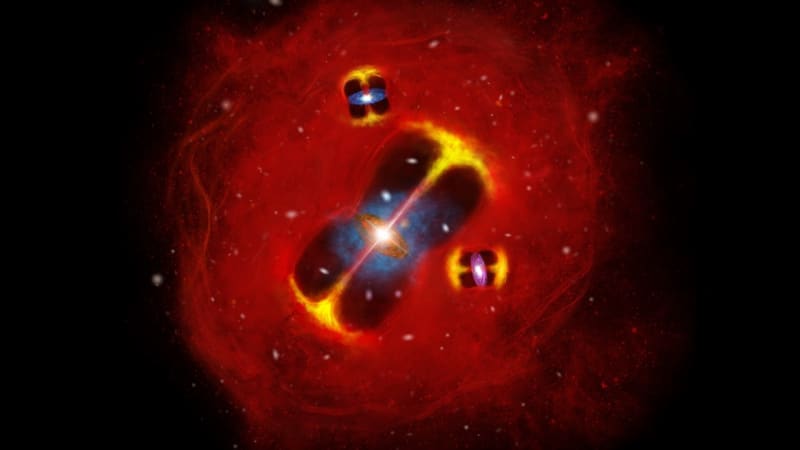
Using Chile's powerful Atacama Large Millimeter/submillimeter Array (ALMA), researchers identified the galaxy cluster SPT2349-56, an astonishing collection of more than 30 galaxies packed into a remarkably compact space. What makes this discovery particularly thrilling is that this ancient cluster is breaking records and defying expectations in ways that are pushing the boundaries of astrophysics forward.
The cluster's atmosphere is extraordinarily hot—at least five times hotter than scientists predicted possible for such a young cosmic structure. Rather than being a problem, this unexpected finding is opening up wonderful new avenues of research and understanding about how the early universe operated.
"This tells us that something in the early universe was already pumping huge amounts of energy into the surroundings and shaping the young cluster, much earlier and more strongly than we thought," explained Scott Chapman, a professor of astronomy at Dalhousie University. The likely culprits? Three recently discovered supermassive black holes within the cluster that appear to have been incredibly active cosmic engines.
Lead researcher Dazhi Zhou, a PhD candidate at the University of British Columbia, describes the discovery with palpable excitement: "We didn't expect to see such a hot cluster atmosphere so early in cosmic history. This gas is even hotter and more energetic than what we find in many present-day clusters."
The team measured the cluster's temperature using an elegant technique called the Sunyaev-Zeldovich effect, which reveals how galaxy clusters interact with the cosmic microwave background radiation—the universe's oldest light. This method beautifully demonstrates how creative scientific thinking can unlock secrets from billions of years ago.
What makes SPT2349-56 particularly special is that it appears to be fully formed and gravitationally bound, unlike other protoclusters from similar cosmic epochs. This suggests the early universe was far more dynamic and capable of rapid development than previously imagined—a testament to the incredible forces at work in cosmic evolution.
The cluster is also a stellar nursery on an epic scale, with stars forming at a rate five thousand times faster than in our own Milky Way galaxy. This frenetic star formation, combined with active black holes and the superheated atmosphere, creates a fascinating cosmic laboratory that's helping scientists understand how present-day galaxy clusters came to be.
"We want to figure out how the intense star formation, the active black holes and this overheated atmosphere interact," said Zhou, outlining an exciting research agenda that will keep astronomers busy for years to come.
This groundbreaking discovery, published in the prestigious journal Nature, reminds us that the universe continues to surprise and inspire us. Each unexpected finding like SPT2349-56 doesn't just challenge our current models—it invites us to develop better, more comprehensive theories about cosmic evolution. The early universe, it turns out, was far more sophisticated and energetic than we ever imagined, and that's something worth celebrating.
More Images
Based on reporting by Google News - Science
This story was written by BrightWire based on verified news reports.
Spread the positivity! 🌟
Share this good news with someone who needs it
More Good News
 🌐 Global News
Jupiter's Dazzling January Show Promises Spectacular Stargazing for Everyone
 🌐 Global News
Stunning Milky Way Photo Captures La Palma's World-Class Night Sky Wonder
 🌐 Global News
Groundbreaking Discovery Reshapes Our Understanding of the Early Universe
Joke of the Day
Why did the dog apply for a job at the bank?
Explore Categories
Quote of the Day
"The greatest thing you'll ever learn is just to love and be loved in return."
— Moulin Rouge (from the film, popularized by Ewan McGregor)