Groundbreaking Discovery Reshapes Our Understanding of the Early Universe
Astronomers have made an extraordinary discovery that's rewriting cosmology textbooks – an ancient galaxy cluster that challenges everything we thought we knew about the universe's infancy. This fascinating find opens exciting new frontiers in our quest to understand how galaxies form and evolve.
In a thrilling breakthrough that showcases the power of human curiosity and scientific perseverance, an international team of astronomers has uncovered something truly remarkable in the depths of space – a discovery so extraordinary that it's prompting scientists to rethink our understanding of the early universe.
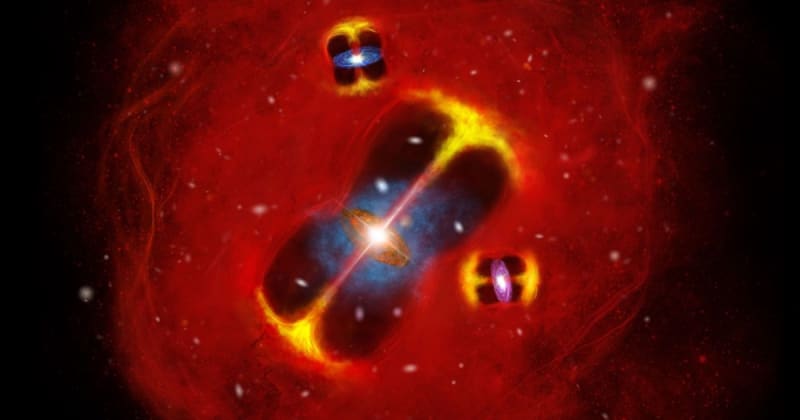
Led by Dazhi Zhou, a PhD candidate at the University of British Columbia, the research team was examining one of the oldest regions of the known universe when they stumbled upon an ancient galaxy cluster that shouldn't exist according to our current models. Dating back to just 1.4 billion years after the Big Bang – approximately 12 billion years ago – this celestial wonder is far hotter and more energetic than anything scientists predicted could exist at that time.
"We didn't expect to see such a hot cluster atmosphere so early in cosmic history," Zhou shared enthusiastically. The discovery was so remarkable that even the lead researcher initially doubted the readings. "At first I was skeptical about the signal as it was too strong to be real," he admitted. "But after months of verification, we've confirmed this gas is at least five times hotter than predicted, and even hotter and more energetic than what we find in many present-day clusters."
Rather than presenting a problem, this unexpected finding represents an exciting opportunity to expand our knowledge. The discovery suggests that the early universe was far more dynamic and energetic than previously imagined, painting a picture of a cosmos that was already bustling with activity in its youth.
The research team believes they've identified the source of this extraordinary energy: three supermassive black holes at the cluster's core that were already pumping massive amounts of energy into their surroundings. "This tells us that something in the early universe was already shaping the young cluster much earlier and more strongly than we thought," explained coauthor Scott Chapman from Dalhousie University.
The team made their groundbreaking observations using the Atacama Large Millimeter/submillimeter Array (ALMA) in Chile, examining a "baby" galaxy cluster called SPT2349-56. This cosmic nursery is truly impressive in scale – its core alone stretches roughly half a million light-years across, comparable to the halo surrounding our entire Milky Way galaxy. Even more astonishing, it spawns stars more than 5,000 times faster than our own galaxy.
This discovery demonstrates that galaxy clusters evolved in far more explosive and dramatic ways than scientists previously thought, driven by intense interactions between multiple supermassive black holes alongside gravitational forces.
"Understanding galaxy clusters is the key to understanding the biggest galaxies in the universe," Chapman noted optimistically. The team is now embarking on the exciting challenge of unraveling how the intense star formation, active black holes, and superheated atmosphere all worked together in this young system.
This remarkable finding reminds us that the universe still holds countless mysteries waiting to be uncovered. Each discovery like this one doesn't just answer questions – it opens doors to entirely new areas of exploration, pushing the boundaries of human knowledge ever outward and inspiring the next generation of cosmic explorers.
Based on reporting by Futurism
This story was written by BrightWire based on verified news reports.
Spread the positivity! 🌟
Share this good news with someone who needs it
More Good News
 🌐 Global News
Astronomers Make Thrilling Discovery of Ancient Galaxy Cluster That Rewrites Cosmic History
 🌐 Global News
Jupiter's Dazzling January Show Promises Spectacular Stargazing for Everyone
 🌐 Global News
Stunning Milky Way Photo Captures La Palma's World-Class Night Sky Wonder
Joke of the Day
Why don't scientists trust atoms?
Explore Categories
Quote of the Day
"The only way to do great work is to love what you do."
— Steve Jobs