Australia and EU Cut China Dependence With Minerals Deal
Australia and the European Union just signed a historic trade deal that removes nearly all tariffs on critical minerals, reducing reliance on China's 90 percent control of rare earth processing. The eight-year agreement promises to strengthen supply chains for everything from electric cars to smartphones.
After eight years of negotiations, Australia and the European Union have finally sealed a trade deal that could reshape global supply chains for critical minerals.
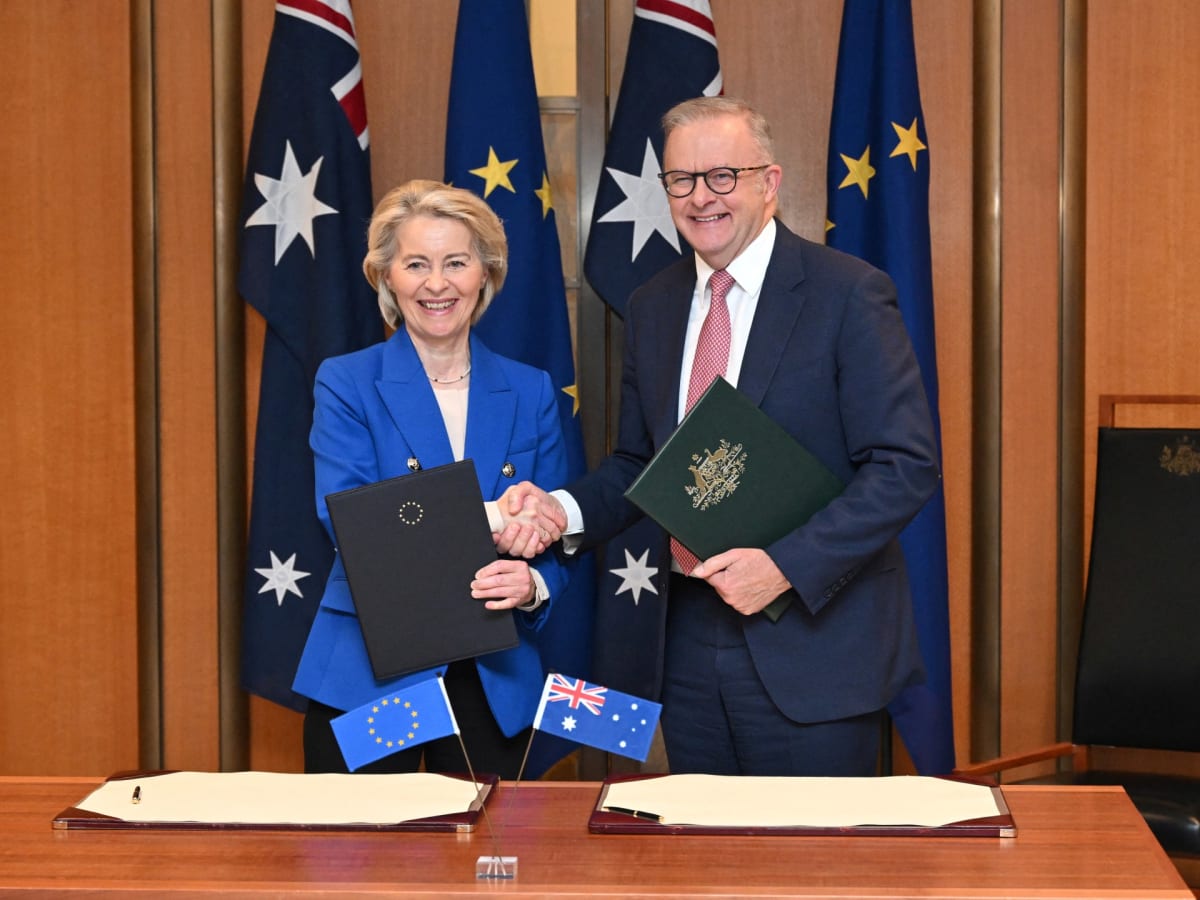
The agreement, signed Tuesday by European Commission President Ursula von der Leyen and Australian Prime Minister Anthony Albanese, eliminates tariffs on nearly all Australian critical mineral exports to Europe. It's a strategic move to counter China's overwhelming dominance in rare earth processing, where it controls roughly 90 percent of the global market.
These minerals aren't just rocks. They're essential ingredients in electric cars, lithium-ion batteries, LED televisions, and camera lenses. Without diverse supply sources, entire industries remain vulnerable to disruption.
Von der Leyen spoke directly to this concern when addressing Australia's parliament. "We cannot be over-dependent on any supplier for such crucial ingredients, and that is precisely why we need each other," she said.
The deal delivers real economic benefits on both sides. Australia expects to gain about $7 billion annually, while EU companies will save $1.2 billion yearly in eliminated duties. Over the next decade, EU exports to Australia could grow by 33 percent as more than 99 percent of tariffs disappear.
The numbers show how substantial this partnership already is. EU firms exported $43 billion worth of goods to Australia in 2025 and $33 billion in services in 2023. As a bloc, the EU ranks as Australia's third-largest trading partner and second-largest source of foreign investment.
The Ripple Effect
This agreement sends ripples far beyond trade statistics. By diversifying critical mineral supply chains, both regions gain security against potential disruptions. Industries dependent on these materials can plan with greater confidence. Countries watching from the sidelines see a working model for reducing dependence on single suppliers.
The partnership also strengthens democratic alliances in an uncertain global landscape. When like-minded nations cooperate on strategic resources, they build resilience together. Other countries rich in critical minerals may now see opportunities to join this growing network.
For consumers, stable supply chains mean more reliable access to the technology that powers modern life. Electric vehicle manufacturers, renewable energy companies, and electronics makers all benefit when raw materials flow predictably.
Eight years might seem like a long time to negotiate a trade deal, but the result creates a foundation for decades of cooperation on resources that will only grow more vital as the world transitions to clean energy and advanced technology.
Based on reporting by Al Jazeera English
This story was written by BrightWire based on verified news reports.
Spread the positivity!
Share this good news with someone who needs it