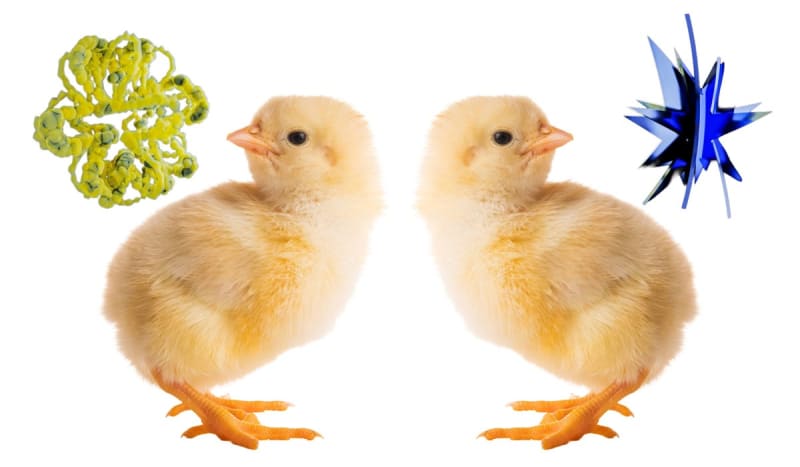
Baby Chicks Pass Bouba-Kiki Test, Rewrite Language Theory
Newborn chickens match sounds to shapes just like humans do, suggesting the famous "bouba-kiki" effect isn't unique to language after all. The discovery pushes back our understanding of this ability by 300 million years.
Scientists just discovered that baby chickens have something surprising in common with humans: they think "bouba" sounds round and "kiki" sounds spiky.
For over a century, researchers believed this quirky ability to link sounds with shapes might explain how humans first created language. The theory suggested our ancestors built words on these natural connections between sound and meaning, making communication possible.
But the new study, published in Science, throws that idea into question. If chickens share this skill, it can't be uniquely human after all.
Researchers at the University of Padua tested newly hatched chicks within their first hours of life. They placed the birds in front of two panels: one with rounded, flowery curves and another with sharp, spiky edges. Then they played recordings of humans saying "bouba" or "kiki."
The results were stunning. When chicks heard "bouba," 80 percent approached the round shape first and spent over three minutes exploring it. They spent less than one minute with the spiky shape. When they heard "kiki," their preferences completely flipped.
Because the tests happened so quickly after hatching, the chicks couldn't have learned these associations from experience. The ability appears to be hardwired into their brains.
"We parted with birds on the evolutionary line 300 million years ago," says linguist Aleksandra Ćwiek, who wasn't involved in the study. "It's just mind-blowing."
Previous research showed the bouba-kiki effect works across all human cultures and writing systems worldwide. Human babies show the same preferences before they learn to speak. When scientists tested great apes in 2019 and 2022, the primates failed the test, which seemed to confirm it was uniquely human.
Why This Inspires
This discovery opens exciting new doors in understanding how brains work. Rather than being a clue about language evolution, the bouba-kiki effect reveals something deeper about how minds connect different senses together.
The findings also solve a puzzle. Scientists can now rule out the theory that these associations come from mouth shapes when speaking, since chickens don't have lips. Instead, the effect likely stems from how objects actually behave in nature: round objects make continuous, low-frequency sounds when they roll or fall, while spiky objects create sharper noises.
This built-in understanding helps newborn animals quickly make sense of their world, possibly to find food or avoid danger. It's a survival skill that evolved hundreds of millions of years ago.
"Even if language is unique to humans," says researcher Maria Loconsole, "that doesn't mean that it comes from an ability that is unique to humans."
The same basic tools our brains use to connect sight and sound gave chickens survival skills and eventually helped humans build something extraordinary: the gift of language.
More Images



Based on reporting by Scientific American
This story was written by BrightWire based on verified news reports.
Spread the positivity!
Share this good news with someone who needs it