Bats Navigate Dense Forests Using Motion-Based Echolocation
Scientists discovered how bats fly through cluttered environments without crashing by detecting motion changes in sound waves. The breakthrough could help make drones and self-driving cars safer in complex spaces.
Scientists just solved a decades-old mystery about how bats zip through dense forests without crashing into thousands of obstacles in the dark.
Researchers at the University of Bristol discovered that bats rely on the Doppler effect to navigate cluttered environments. The Doppler effect is the change in sound pitch that happens when something moves, like how an ambulance siren sounds different as it passes you.
Think about standing at a party with thousands of people talking at once. You'd struggle to hear one voice clearly. That's exactly what bats face when flying through forests full of leaves, branches, and other obstacles creating overlapping echoes.
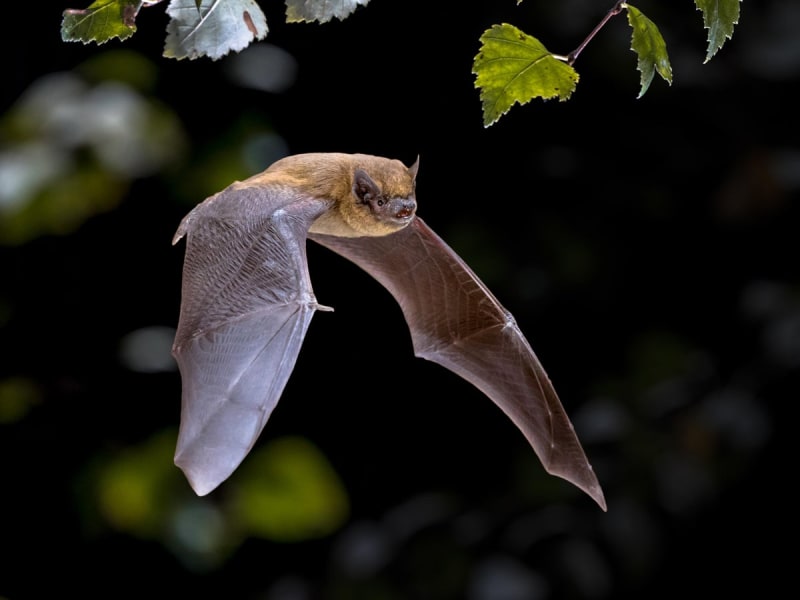
Professor Marc Holderied and his team figured this out using a wild contraption they called the "bat accelerator." The device is an eight-meter tunnel filled with treadmills covered in 8,000 plastic leaves that researchers stapled on by hand. Wild pipistrelle bats flew through the tunnel while the team controlled which direction the fake foliage moved.
The results were clear. When the treadmill moved in the same direction as the bats, they sped up. When it moved toward them, they slowed down. The bats thought they were traveling at different speeds based on the Doppler shifts in their echoes, even though their actual speed stayed constant.
"We tricked them into thinking that their speed is different," Holderied explains. The bats adjusted their flight speed based on how movement changed the sounds bouncing back to them.
The Ripple Effect
This discovery goes beyond understanding nature better. Engineers are already exploring how to apply these findings to navigation systems for drones and self-driving cars, which struggle in cluttered environments like cities or forests.
Research associate Athia Haron from the University of Manchester says this could solve major problems with current technology. "If that pans out, that would benefit a lot of navigation systems that fail in these kinds of cluttered environments," she notes.
The finding also surprised scientists because pipistrelle bats aren't considered Doppler specialists. Some bat species were already known to use this technique extensively, but researchers didn't think common bats like pipistrelles relied on it. The study suggests this navigation method might be more widespread in nature than previously thought.
Nature's engineers continue teaching us innovative solutions to modern technical challenges, one echolocating flight at a time.
More Images




Based on reporting by Scientific American
This story was written by BrightWire based on verified news reports.
Spread the positivity!
Share this good news with someone who needs it


