BC Teen's River Find Sparked Island Fossil Rush
When 13-year-old Heather Trask spotted strange rocks on a riverbed in 1988, she had no idea she'd just discovered BC's first complete marine dinosaur. Her find launched a paleontology movement that turned amateur hobbyists into world-class fossil hunters.
A father-daughter fossil hunt on Vancouver Island changed the course of Canadian paleontology forever.
In late 1988, Mike Trask and his 13-year-old daughter Heather were exploring the Puntledge River near Courtenay when they stumbled upon grey tubular rocks that looked oddly like vertebrae. Mike brought them home and called the Royal BC Museum, where paleobotanist Richard Hebda agreed to take a look.
Hebda had low expectations. His last fossil tip turned out to be dirtbike tracks in dried mud.
But when he arrived at the Trask home and examined the bones warming by the fireplace, he knew this was different. The specimens were real vertebrae from a large animal, something unprecedented on Vancouver Island at that time.
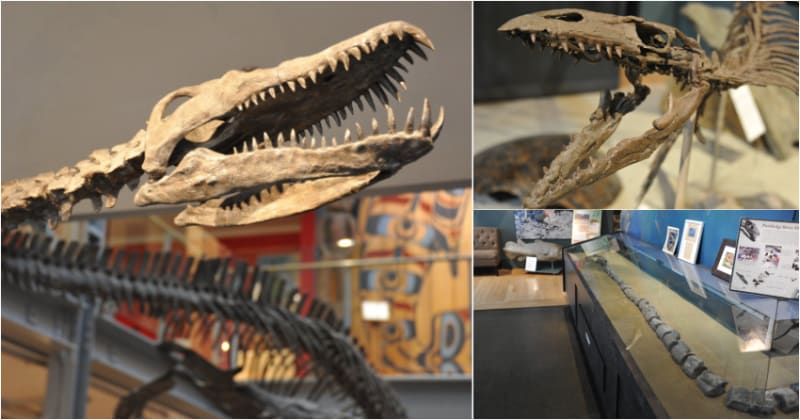
Expert Betsy Nicholls from the Royal Tyrell Museum identified them as belonging to an elasmosaur, a 85-million-year-old marine reptile that resembled the Loch Ness monster with its long neck and bulbous body. It was the first specimen of its kind found west of the Canadian Rockies.
Mike Trask wanted to do right by science. He knew more bones might be buried at the site, so he partnered with paleontologist Rolf Ludvigson to plan a proper excavation.
In March 1991, the Courtenay Museum placed a newspaper ad seeking 20 volunteers for a dig. More than 50 people showed up on the first day, braving near-freezing rain that threatened to turn to snow.
Every weekend for three months, volunteers excavated 100 cubic metres of earth from the riverbed. Underneath all that dirt and shale, they found a nearly complete skeleton.
The Ripple Effect
The Trask discovery opened floodgates across Vancouver Island. Amateur fossil hunters realized their backyards held prehistoric treasures, and dozens began exploring local rivers and beaches with new purpose.
The enthusiasm sparked the creation of BC's first paleontological society, which quickly grew to over 100 members on Vancouver Island alone. Many amateur hunters went on to make hundreds of new discoveries, fundamentally reshaping what scientists knew about the region's ancient past.
"It opened a door, not only into a room, but into another gigantic world," Hebda said in a 2026 interview. Today, the elasmosaur replica stands proudly in the Courtenay Museum and Paleontology Centre, inspiring new generations of fossil hunters.
One curious teenager and her dad proved that world-changing discoveries don't require advanced degrees, just curiosity and a willingness to look closer at the rocks beneath our feet.
Based on reporting by Google: fossil discovery
This story was written by BrightWire based on verified news reports.
Spread the positivity!
Share this good news with someone who needs it