Blue Light Method Speeds Up Complex Drug Discovery
Scientists use aquarium-style LED lights to build complicated drug molecules in half the time. The breakthrough could help researchers create more effective medicines faster.
A blue light sitting on a laboratory shelf is helping scientists solve one of medicine's most expensive puzzles: how to build better drugs without spending years in the lab.
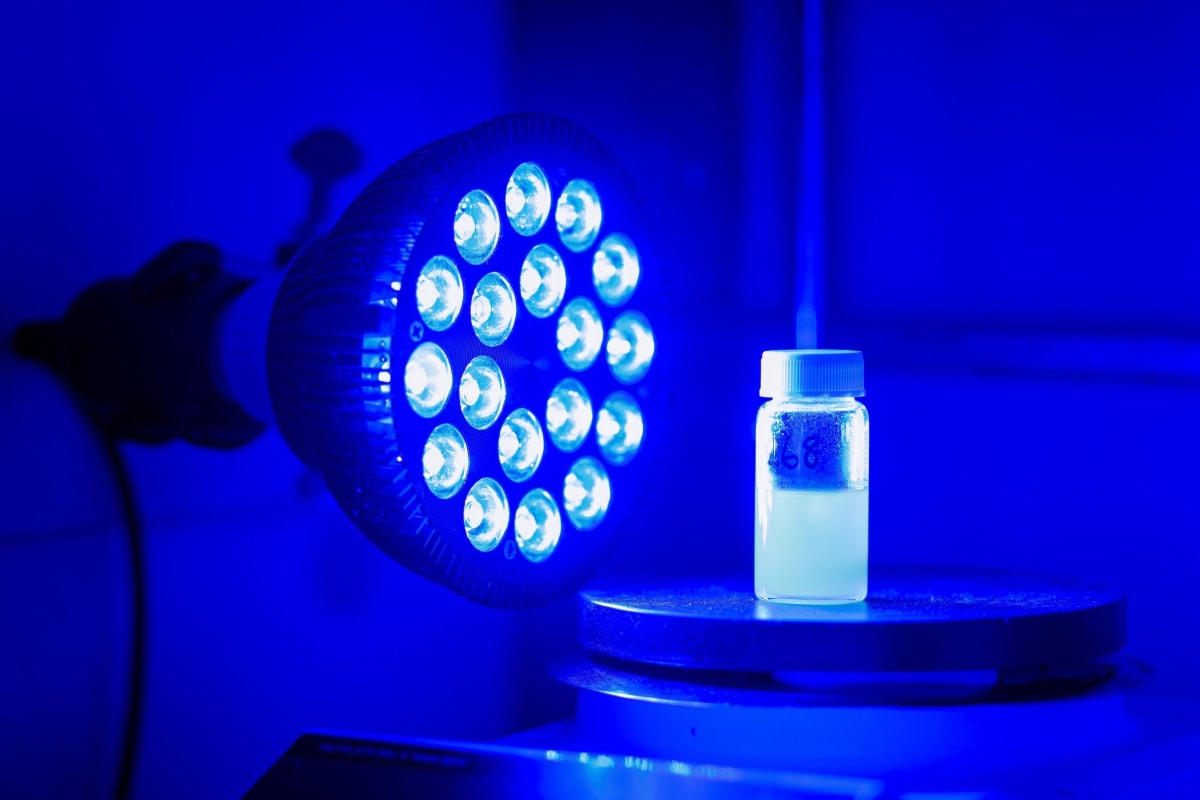
Researchers at the University at Buffalo have developed a method that uses LED lights—the same kind found in fish tanks and indoor gardens—to create complex drug molecules in fewer steps. The technique, published in Science, cuts down the time and cost of drug discovery by doing two molecular modifications at once instead of one.
Most medicines are built from small carbon-based molecules. Their shape determines how well they work in the body. Simple, flat structures can be effective, but three-dimensional molecules often fit their biological targets with greater precision, leading to better results with fewer side effects.
The challenge has always been creating those complex shapes. Traditional chemistry requires multiple reactions, each adding time, cost, and chances for failure. Every extra step means another opportunity for something to go wrong.
The new approach changes that equation. When blue LED light hits a special catalyst inside a solution, it activates common carbon-halogen molecules chemists already use. For a brief window, researchers can attach new molecular groups to two neighboring carbon atoms simultaneously.
"We've used the relatively mild conditions of visible light to expand what chemists can do," says lead researcher Patricia Musacchio, assistant professor of chemistry at Buffalo. The team conducts experiments in small illuminated boxes they've nicknamed "Buffalo boxes," lined up on laboratory shelves.
The visible light matters because it's gentler than the ultraviolet light some chemical reactions require. UV light can damage delicate organic compounds or trigger unwanted reactions. Blue light provides just enough energy to activate the catalyst without destroying the molecules being built.
The Ripple Effect
The breakthrough could accelerate the entire drug development pipeline. Medicinal chemists test hundreds or thousands of molecular variations while searching for promising candidates. Each modification reveals whether a compound binds better to its target or avoids harmful interactions elsewhere in the body.
Combining two modifications into one reaction saves more than lab time. It reduces the number of intermediate compounds that must be produced, isolated, and tested. That means fewer materials, less waste, and faster results.
Jennifer Hirschi, associate professor at Binghamton University and co-author of the study, emphasizes the practical impact. "More changes in fewer steps is crucial when creating small-molecule drugs," she says.
The team plans to work with pharmaceutical companies to adapt the method for specific drug targets. They also believe the strategy could eventually support other types of molecular transformations beyond the initial application.
The research points toward a future where chemists can not only make drugs faster but also tackle more challenging medical goals with more sophisticated molecular designs.
More Images
Based on reporting by Google News - Breakthrough Discovery
This story was written by BrightWire based on verified news reports.
Spread the positivity!
Share this good news with someone who needs it