Bonobo Named Kanzi Pretends at Tea Party, Stuns Scientists
A 43-year-old bonobo just became the first non-human primate to demonstrate imagination in a controlled experiment. Scientists say this discovery changes what we thought made humans unique.
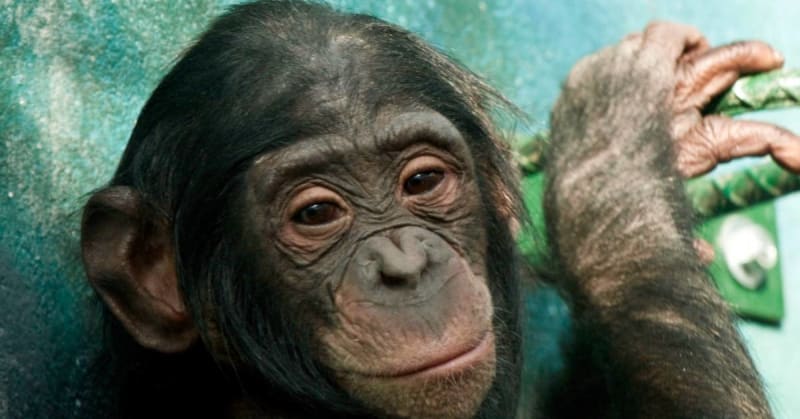
A bonobo named Kanzi sat down for a tea party and proved that imagination isn't just a human superpower.
Researchers at Johns Hopkins University invited the 43-year-old bonobo to participate in a series of pretend play experiments. They wanted to test whether apes could truly imagine objects that weren't really there.
In one test, an experimenter pretended to pour juice into two clear cups, then acted out dumping one before asking Kanzi where the juice was. Even when they switched the cups' positions, Kanzi consistently pointed to the correct one.
In another experiment, researchers pretended to place an invisible grape into one of two jars. After acting like they emptied one container, they asked Kanzi to find the grape. He answered correctly most of the time.
"It's extremely striking and very exciting that the data seem to suggest that apes, in their minds, can conceive of things that are not there," said Dr. Amalia Bastos, the study's first author from the University of St. Andrews. The research was published in Science on February 5.
Before this study, no controlled experiments had ever proven pretend play in animals. Christopher Krupenye, a Johns Hopkins assistant professor who co-authored the research, explained that the biggest challenge was designing an experiment that could show animals tracking objects that weren't actually present.
Why This Inspires
This discovery reshapes our understanding of what makes us human. For decades, scientists believed imagination was uniquely ours, but Kanzi proved that mental life extends beyond our species.
"Jane Goodall discovered that chimps make tools, and that led to a change in the definition of what it means to be human," Krupenye noted. This finding invites us to reconsider what mental experiences other creatures might have.
Because we share this ability with bonobos, researchers believe this trait likely dates back to a common ancestor living 6 to 9 million years ago. That means imagination has been part of our shared evolutionary story far longer than we realized.
Bonobos are highly endangered, found only in the Democratic Republic of Congo where their population continues to decline due to habitat loss and poaching. Scientists have long known bonobos are intelligent, sometimes carrying sticks like a mother would hold an infant or moving "imaginary" blocks after playing with real ones.
One tea party just reminded us that the line between human and animal minds is far thinner than we ever imagined.
More Images

Based on reporting by Good Good Good
This story was written by BrightWire based on verified news reports.
Spread the positivity!
Share this good news with someone who needs it