Brain Training Cuts Alzheimer's Risk by 25% in 20-Year Study
A groundbreaking 20-year study has proven for the first time that a specific type of brain training can reduce the risk of Alzheimer's disease and dementia by 25%. This is the first randomized controlled trial of any intervention to show such powerful protection against cognitive decline.
Scientists just proved something remarkable: training your brain to work faster can significantly lower your chances of developing Alzheimer's disease.
A 20-year study following nearly 3,000 people over age 65 has delivered the first proof that we can actively prevent dementia. The research, called the ACTIVE study, started in 1998 and tested different types of brain training to see what actually works.
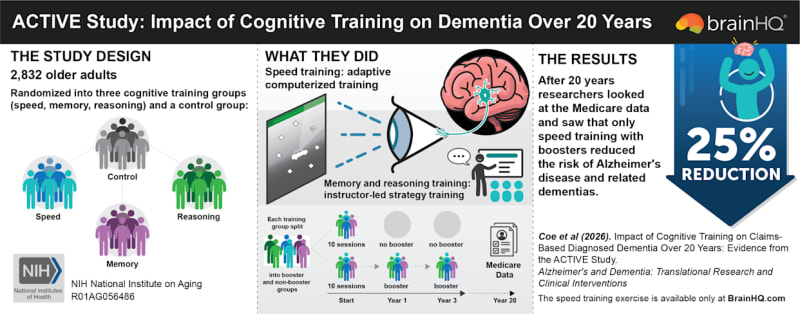
Researchers divided participants into four groups. Two groups learned memory strategies and reasoning techniques through classroom instruction. The third group did something different: they trained on a computerized exercise designed to boost visual speed and attention.
The speed training exercise challenged people to identify images quickly while noticing details in their peripheral vision, getting progressively faster to push their brain's processing speed. Participants did about an hour of training twice a week for five weeks, totaling around 10 hours. Some continued with booster sessions over the years, completing about 23 hours total.
All three training groups saw short-term benefits. But when researchers linked the data to Medicare records two decades later, they discovered something extraordinary. The speed training group with boosters showed a 25% reduction in Alzheimer's and dementia diagnoses over 20 years.
Neither memory training nor reasoning training showed this protective effect. Only making the brain faster and maintaining that speed with annual boosters delivered the breakthrough result.
Why This Inspires
This is the first randomized controlled trial ever to prove that any intervention can reduce dementia risk. Previous studies could only show associations between healthy habits and brain health, but couldn't prove cause and effect.
Dr. Michael Merzenich, a brain plasticity expert at UCSF, notes the power of getting such strong results from relatively limited training. "Just imagine if the participants did more of this type of adaptive online training over time, targeting more brain functions," he says. "How much stronger would the benefits be?"
The speed training exercise from the study is now available as "Double Decision" on the BrainHQ platform. Participants also reported safer driving, better mood, and more confidence alongside the dementia protection.
The implications are profound: we've entered the age of dementia prevention, where brain health can be actively protected through targeted training, just as physical exercise and nutrition can prevent Type 2 diabetes.
Hope just got a powerful upgrade in the form of 23 hours that could change everything.
More Images


Based on reporting by Google News - Health Breakthrough
This story was written by BrightWire based on verified news reports.
Spread the positivity!
Share this good news with someone who needs it