.png)
British Lab Launches to Study Disease-Causing Proteins
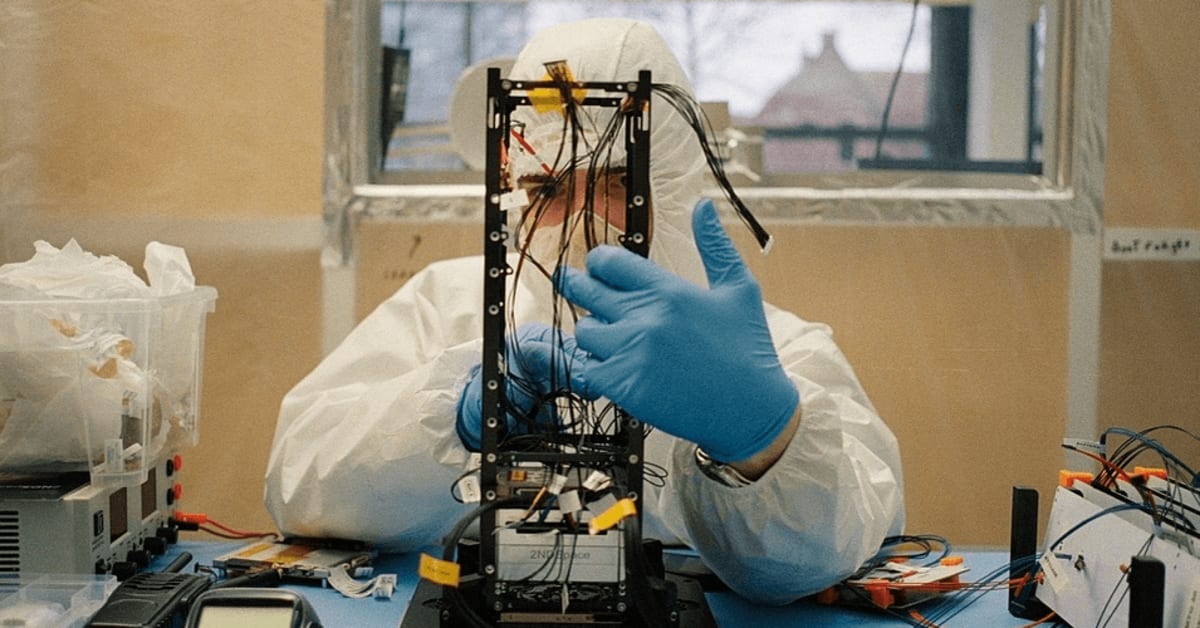
A British startup just sent a grapefruit-sized lab into orbit to study proteins linked to Alzheimer's and Parkinson's. In space, these shape-shifting proteins might finally hold still long enough for scientists to understand them.
Scientists just launched a revolutionary experiment that could unlock mysteries about diseases like Alzheimer's, Parkinson's, and certain cancers.
Mass Balance, a British startup, sent a self-running laboratory into orbit Tuesday aboard a SpaceX rocket. The grapefruit-sized device will spend the next few months automatically testing how cells grow and function in zero gravity, beaming data back to Earth.
The target? Disordered proteins that constantly change shape here on Earth, making them nearly impossible to study. These tricky proteins play a role in age-related diseases that affect millions of people worldwide.
Gravity creates a surprising problem for protein research. On Earth, heat flows through liquids and heavy compounds sink to the bottom, muddying the data scientists need. "When you take away gravity, a lot of weird and wonderful things happen, some of which will be very valuable for life sciences," says Toby Call, the company's cofounder and CEO.
In space, those disordered proteins might finally hold still long enough for researchers to image them properly. That data could fill critical gaps in AI models like Google's AlphaFold, which struggle to predict how these proteins behave and respond to medicines.
For this first mission, the team is testing whether their autonomous system actually works in orbit. The device will monitor a chemical reaction using light sensors, confirming everything functions as planned before moving to more complex protein experiments.
The approach differs from other space biotech startups in one clever way. Mass Balance won't try to bring the lab back to Earth, avoiding the extreme heat and stress of reentry. That keeps costs down and engineering simpler.
The Ripple Effect
This orbiting laboratory represents more than just one experiment. Mass Balance plans to license the data and AI models trained on their space research, creating a new resource for pharmaceutical companies working on treatments for age-related diseases.
Other biotech firms are racing to space too. British company BioOrbit launched crystals for cancer medications in May, while American firm Varda Space Industries processes pharmaceuticals under microgravity.
The goal isn't to make space research exotic or exclusive. Call wants to make orbiting labs "boring, reliable, and just another research environment" that scientists can routinely access.
What started as a wild idea could become a standard tool in the fight against diseases that have puzzled researchers for decades.
More Images




Based on reporting by Wired
This story was written by BrightWire based on verified news reports.
Spread the positivity!
Share this good news with someone who needs it