Carnegie Mellon Gets $20M to Build AI Science Lab Network
Carnegie Mellon's AI Science Foundry just scored up to $20 million to become a cornerstone of America's first national network of AI-powered research labs. The system can run dozens of experiments simultaneously, cutting scientific discovery timelines from decades to months.
Imagine if scientists could run experiments around the clock, testing hundreds of possibilities at once instead of one at a time. That future just got $20 million closer to reality.
Carnegie Mellon University's AI Science Foundry has been selected by the National Science Foundation to help build a national network of AI-enabled laboratories. The four-year award will transform how researchers across America make scientific breakthroughs.
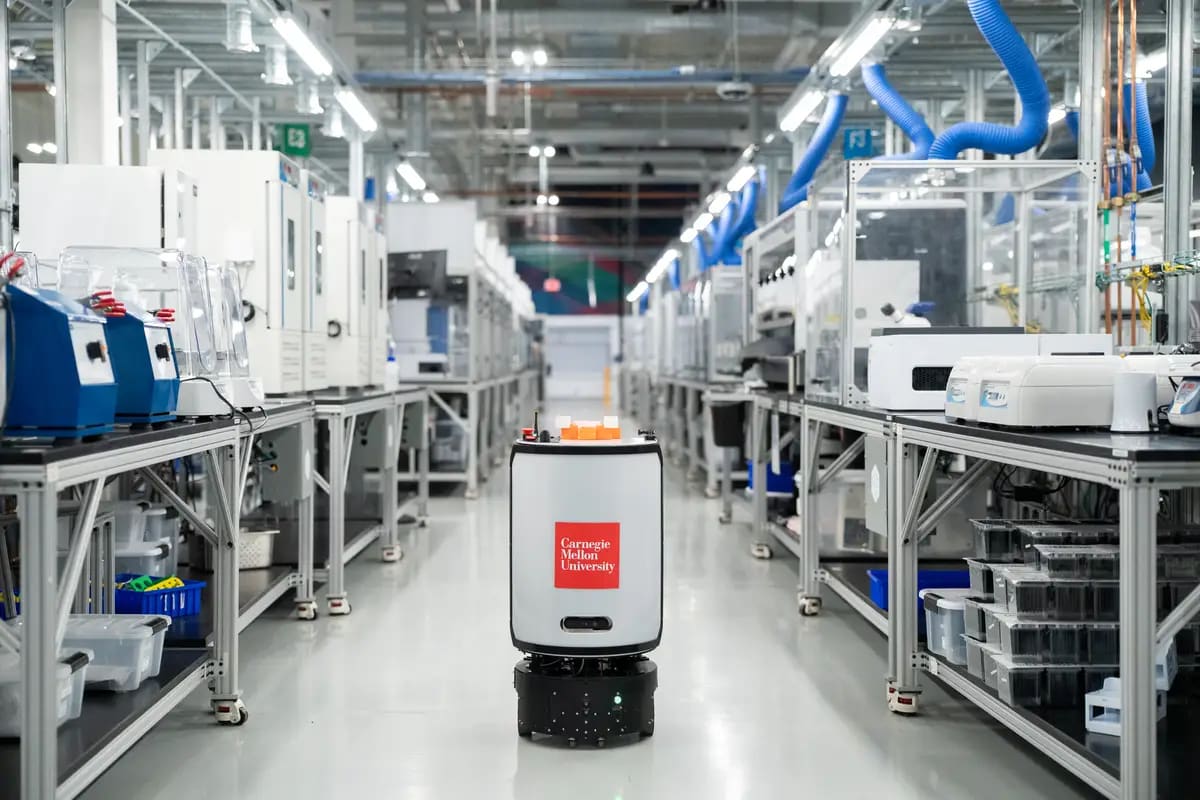
The Foundry is unlike any research facility in the world. It combines artificial intelligence, robotics, automation and supercomputing into a single intelligent system that connects more than 80 robotically controlled instruments across biology, chemistry and materials science.
Here's what makes it revolutionary: researchers can design and run experiments remotely across dozens of instruments at once. The AI learns from each test, continuously improving its approach without human intervention for routine tasks.
The impact could be staggering. Discovery timelines that traditionally take decades could shrink to years or even months. Scientists can explore vastly larger experimental spaces, testing thousands of combinations that would be impossible through traditional trial and error.
The facility will initially tackle pressing challenges like developing better cooling systems for data centers, creating sustainable pigments from microbial biomaterials, advancing personalized medicine through organoid research, and designing aluminum alloys that can withstand extreme heat for next-generation aircraft.
But this isn't just about Carnegie Mellon. The university will partner with other universities, national laboratories, industry and government collaborators to create a connected network of AI labs serving researchers nationwide. Think of it as building the internet, but for scientific experimentation.
Why This Inspires
This project addresses one of science's biggest bottlenecks: the slow, expensive process of trial and error. By automating routine experiments and using AI to identify promising research directions, scientists can focus their creativity on asking bigger questions and interpreting results.
The Foundry will also train the next generation of researchers through workshops and hands-on programs, ensuring students and professionals learn to work alongside autonomous systems. This democratizes access to cutting-edge technology that was previously available only at elite institutions.
The initiative fits into the broader Genesis Mission, the U.S. government's push to build AI-enabled research infrastructure for tackling national priorities in energy, manufacturing, biotechnology and materials science. Carnegie Mellon is leading three additional Genesis Mission projects.
By creating open standards, shared software and data resources, the network ensures discoveries can be replicated and built upon by researchers everywhere. This collaborative approach could accelerate solutions to some of humanity's most pressing challenges, from climate change to disease.
Scientific discovery just got a massive upgrade, and the benefits will ripple across every field of research for generations to come.
Based on reporting by Google: scientific discovery
This story was written by BrightWire based on verified news reports.
Spread the positivity!
Share this good news with someone who needs it