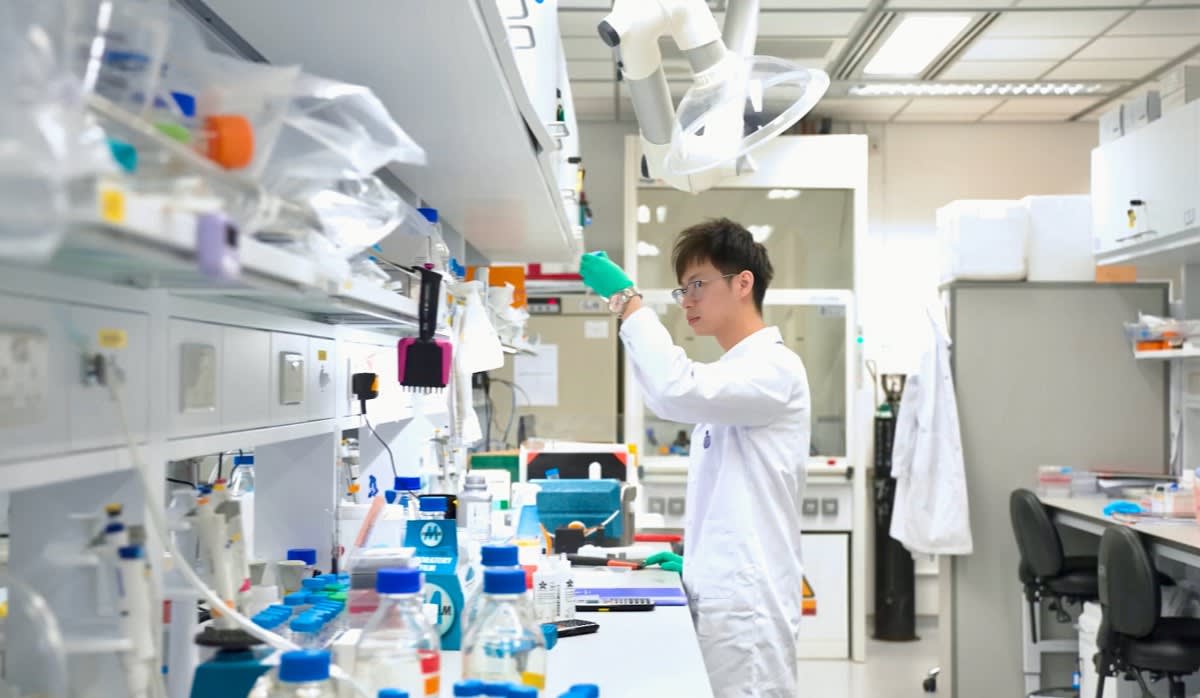
Chemistry Breakthrough Turns 25, Now Saving Lives Daily
A simple idea about making molecules "click" together celebrated 25 years since revolutionizing medicine, biology, and engineering. The discovery earned a Nobel Prize and now helps create lifesaving drugs faster than ever.
Twenty-five years ago, three chemists published a paper that would change how scientists build molecules forever, and today their breakthrough is helping create new medicines and save lives around the world.
In 2001, chemists H.C. Kolb, M.G. Finn, and K. Barry Sharpless introduced "click chemistry" in a scientific journal. They discovered specific chemical reactions that snap molecules together perfectly, like LEGO bricks, without creating any waste or mess.
The beauty of click chemistry lies in its simplicity. Traditional chemistry often produces unwanted byproducts and requires complicated steps. Click reactions work cleanly and efficiently in solution, connecting exactly what scientists want with zero leftover junk.
Originally designed to speed up drug development, the technique exploded across scientific fields. Biologists use it to study living cells. Engineers build new materials with it. Medical researchers develop targeted cancer treatments. The discovery was so revolutionary that Sharpless won a share of the 2022 Nobel Prize in Chemistry.
The Ripple Effect
The impact reaches far beyond laboratories. Pharmaceutical companies now use click chemistry to create drug candidates in days instead of months. Researchers studying Parkinson's disease have developed new treatments using these reactions. Cancer scientists are designing precision medicines that target tumors while leaving healthy cells untouched.
The technique has also transformed how we study diseases at the molecular level. Scientists can attach fluorescent tags to specific proteins inside living cells, watching biological processes happen in real time. This helps them understand illnesses better and develop more effective treatments.
Materials scientists are getting creative too. They're using click chemistry to build everything from smart drug delivery systems to new types of sensors. The reactions work so reliably that engineers can now design complex molecular structures with confidence.
What makes this story even more inspiring is how accessible the technique has become. Labs around the world, from major universities to small startups, now use click chemistry daily. The original 2001 paper has been cited thousands of times by researchers building on this foundation.
The pharmaceutical industry particularly benefits from the speed and precision. Drug discovery traditionally takes years of trial and error. Click chemistry lets scientists rapidly test thousands of molecular combinations, dramatically accelerating the journey from lab bench to patient bedside.
Today, clinical trials are underway for multiple drugs created using click chemistry principles. Some target rare diseases that previously had no treatment options. Others aim to make existing therapies safer and more effective.
Looking ahead, researchers continue finding new applications. Recent advances combine click chemistry with artificial intelligence to design even better drug candidates. Others are exploring how these reactions could help develop vaccines or fight antibiotic-resistant bacteria.
What started as an elegant solution to a chemistry problem has blossomed into a tool that touches millions of lives, proving that sometimes the simplest ideas create the biggest ripples.
More Images


Based on reporting by Nature News
This story was written by BrightWire based on verified news reports.
Spread the positivity!
Share this good news with someone who needs it