China Installs 54x More Solar and Wind Than Nuclear in 2025
China just proved which clean energy technologies scale fastest, adding enough solar and wind in one year to power millions of homes while nuclear projects lag years behind targets. The gap reveals an unexpected truth about building our clean energy future.
📺 Watch the full story above
China crushed its renewable energy goals six years early while missing nuclear targets by billions of watts, and the pattern shows no signs of changing.
The world's largest energy consumer set a goal to reach 1,200 gigawatts of combined wind and solar by 2030. They hit it in 2024, a full six years ahead of schedule. By the end of 2025, China had installed 640 gigawatts of wind and 1,202 gigawatts of solar power.
Nuclear energy told a different story. China aimed for 58 gigawatts by 2020 but only reached 50. The 2025 target was 70 gigawatts, but actual capacity hit just 62.
This isn't happening because China gave up on nuclear power. The country runs the world's largest reactor construction program and keeps approving new plants. But approval and actual operation are proving to be very different things.
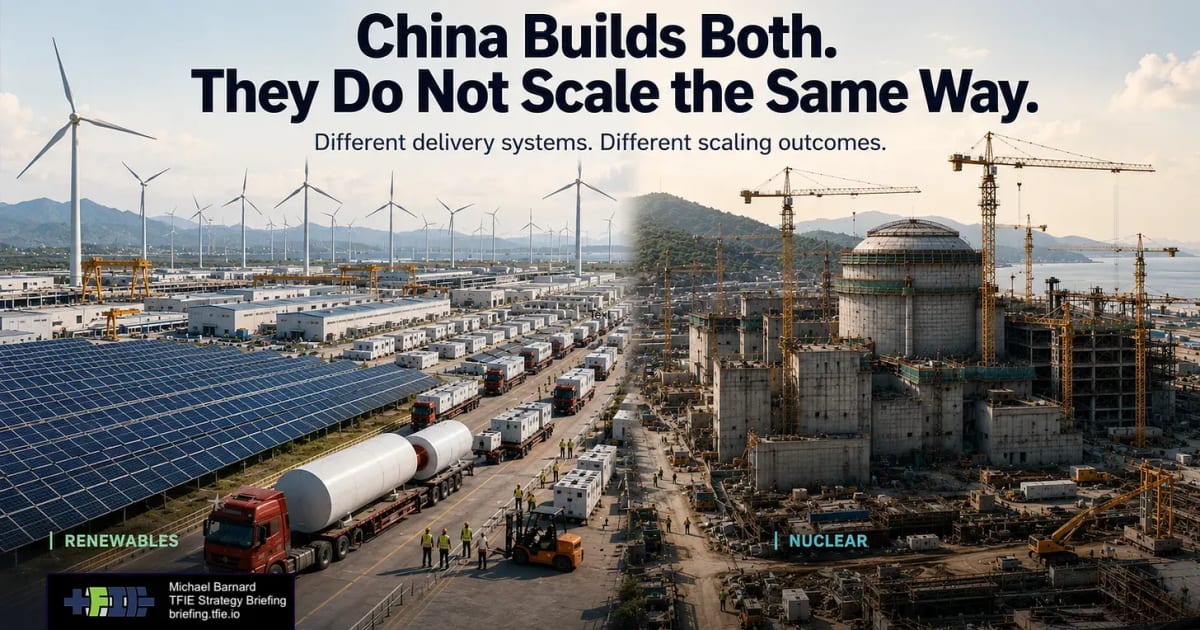
The reason comes down to how each technology gets built. Solar and wind installations work like assembly lines, with factories churning out panels and turbines that crews install across hundreds of projects simultaneously. One delayed project barely affects the national rollout.
Nuclear plants march through years of sequential steps: civil works, equipment installation, testing, fuel loading, and grid connection. A single design issue or approval pause can set back a meaningful chunk of the entire program.
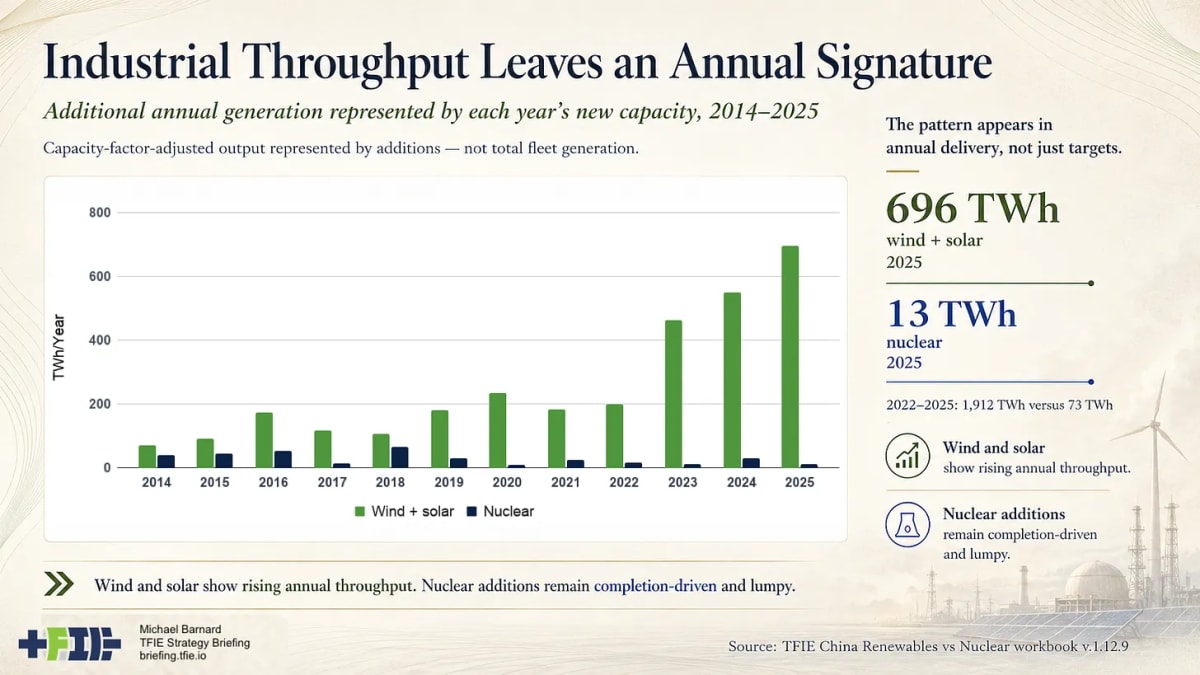
The numbers from 2025 paint a striking picture. New wind capacity will generate about 282 terawatt-hours annually, while new solar adds roughly 414 terawatt-hours. New nuclear capacity? Just 13 terawatt-hours. That's 54 times less generation from nuclear than from wind and solar combined.
Looking at the four-year span from 2022 through 2025, renewables added capacity equivalent to about 1,912 terawatt-hours of annual generation. Nuclear added roughly 73 terawatt-hours during the same period, a ratio of 26 to one.
China has every advantage that's supposed to make nuclear construction easier: centralized planning, state-owned developers, deep supply chains, abundant capital, and experienced engineers. Yet renewables keep winning the installation race.
The Ripple Effect
This pattern matters far beyond China's borders. Countries worldwide are setting climate goals that depend on rapidly scaling clean energy. China's experience shows that factory-made technologies can scale exponentially while project-based systems grow linearly, even under ideal conditions.
The lesson isn't that nuclear power has no future. It's that forecasters need to build predictions from what delivery systems actually demonstrate they can achieve, not from targets and announcements.
As the world races to replace fossil fuels, China just showed us which clean energy technologies can move at the speed we need.
More Images
Based on reporting by CleanTechnica
This story was written by BrightWire based on verified news reports.
Spread the positivity!
Share this good news with someone who needs it