China's 66 Billion Trees Turn Desert Into Carbon Sink
Scientists discovered that China's massive tree-planting program has transformed one of Earth's harshest deserts into a carbon-absorbing ecosystem for the first time. The Taklamakan Desert, once called a "biological void," now captures more carbon than it releases.
One of the world's largest and driest deserts is doing something scientists once thought impossible: it's absorbing more carbon from the air than it releases.
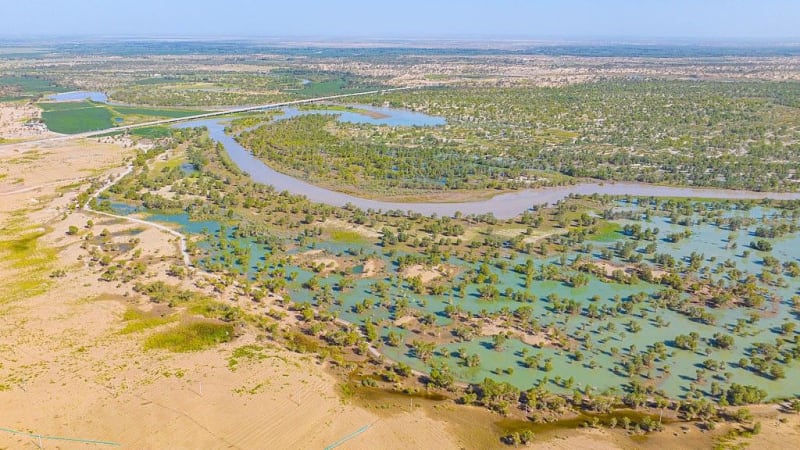
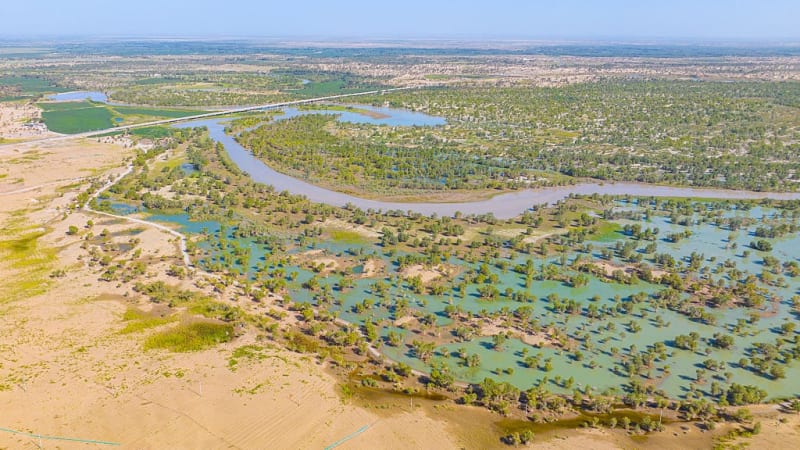
The Taklamakan Desert stretches across 130,000 square miles in northwestern China, roughly the size of Montana. For decades, this harsh landscape has been considered a biological wasteland where almost nothing could survive.
But China has spent the past 46 years planting a forest around the desert's edges. Now, new research reveals that audacious plan is working better than anyone expected.
Starting in 1978, China launched the Three-North Shelterbelt Program, nicknamed the "Great Green Wall." The goal was ambitious: plant billions of trees around the Taklamakan and Gobi deserts to stop the spread of sand. More than 66 billion trees have been planted across northern China to date.
The effort became urgent after massive farmland expansion in the 1950s triggered worse sandstorms. These storms stripped away fertile soil and replaced it with sand, causing the desert to grow steadily for decades.
China completed the forest ring around the Taklamakan in 2024. The project has boosted the country's forest cover from just 10% in 1949 to more than 25% today.
Scientists analyzed 25 years of satellite data and ground observations to measure the impact. They tracked vegetation growth, photosynthesis rates, and carbon dioxide movement in and out of the desert ecosystem.
The Ripple Effect
The results surprised even the researchers. The newly planted vegetation isn't just stopping sand, it's fundamentally changing the desert's chemistry.
The trees and shrubs growing along the desert's edges now capture enough carbon dioxide through photosynthesis to offset what the barren interior releases. That makes the Taklamakan Desert a net carbon sink, a remarkable transformation for one of Earth's most extreme environments.
Yuk Yung, a planetary science professor at Caltech who co-authored the study, called it a first. "We found, for the first time, that human-led intervention can effectively enhance carbon sequestration in even the most extreme arid landscapes," he told Live Science.
The findings showed another surprise: rainfall during the wet season from July to September is now 2.5 times higher than it was 25 years ago. More vegetation may be creating more favorable conditions for rain, which helps even more plants grow.
The research team used data from NASA and the National Oceanic and Atmospheric Administration to confirm their findings. The timing and location of vegetation growth matched perfectly with where China planted trees.
The success proves that even the harshest landscapes can heal when given sustained attention and resources. What was once considered impossible is now documented reality: humans can reverse desertification and turn biological voids into thriving carbon sinks.
More Images



Based on reporting by Live Science
This story was written by BrightWire based on verified news reports.
Spread the positivity!
Share this good news with someone who needs it