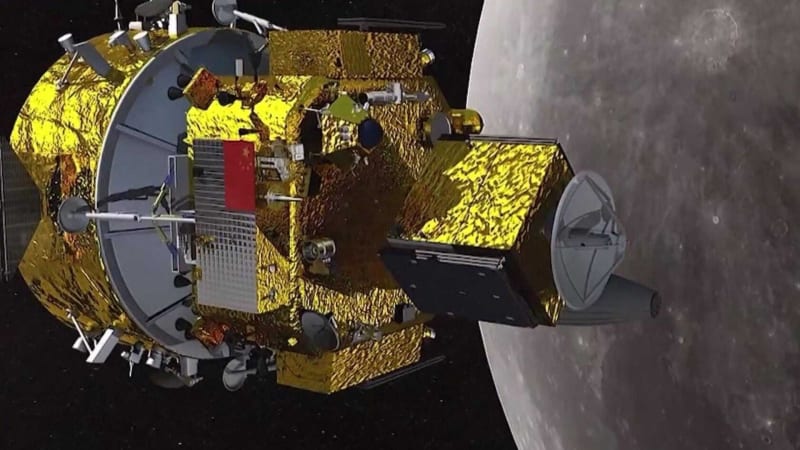
China's Chang'e 7 Mission Set to Make Historic Water Discovery on the Moon
An exciting new chapter in lunar exploration is about to unfold as China prepares to launch Chang'e 7, a groundbreaking mission that could find water ice on the Moon's south pole. This international collaboration represents humanity's collective dream of establishing a sustainable presence on our celestial neighbor.
The Moon is about to welcome remarkable new visitors! China's Chang'e 7 mission, scheduled to launch later this year, promises to be one of the most thrilling lunar explorations yet, bringing us closer to understanding our nearest cosmic companion and paving the way for humanity's future among the stars.
What makes this mission particularly inspiring is its ambitious goal: to search for water ice at the Moon's south pole near the historic Shackleton Crater. This isn't just about scientific discovery—it's about opening doors to sustainable human exploration of space. Water on the Moon could support future lunar bases, providing drinking water, oxygen, and even rocket fuel for missions venturing deeper into our solar system.
The mission showcases the beautiful spirit of international cooperation. While led by China, Chang'e 7 carries scientific instruments from countries around the globe, including Russia, Egypt, Bahrain, Italy, Switzerland, and Thailand. This collaborative approach demonstrates how space exploration unites humanity in pursuit of shared knowledge and wonder.
Dr. Norbert Schörghofer, a senior scientist at the Planetary Science Institute, shares the excitement: "Chang'e 7 is destined to find water ice and make the first in-situ measurements of water ice on the moon." He notes that this mission will give scientists crucial information several years ahead of schedule, accelerating our understanding of lunar resources.
The mission is impressively equipped for success. Chang'e 7 features an orbiter, lander, rover, and an innovative mini-flying probe called a "hopper" that can explore challenging terrain including crater slopes. Together, these components carry 18 scientific instruments designed to comprehensively study the lunar environment. The hopper alone is a marvel of engineering, using active shock-absorption technology to safely land on steep slopes that were previously impossible to explore.
Among the international contributions is a charming addition from Hawaii's International Lunar Observatory Association: a small, wide-field telescope that will capture stunning images of the galactic plane from the Moon's surface. Steve Durst, the founding director, explains that this instrument aims not only to advance lunar science but also to inspire future generations with breathtaking cosmic photography.
The mission builds upon China's consistently successful Chang'e program, which has maintained an impressive track record of launching on schedule. This reliability demonstrates the program's maturity and the dedication of thousands of scientists and engineers working together toward a common goal.
Landing near Shackleton Crater is particularly strategic. While the crater's interior remains in perpetual shadow—potentially harboring ancient ice deposits—the peaks along its rim enjoy almost constant sunlight, perfect for powering solar panels at a future lunar base.
This mission represents more than technological achievement; it embodies humanity's enduring curiosity and our collective aspiration to explore beyond our world. As we look toward November 2026, when Chang'e 7 is expected to touch down, we're witnessing history in the making—a crucial step toward establishing humanity's first permanent foothold on another world, where international cooperation and scientific wonder go hand in hand.
Based on reporting by Space.com
This story was written by BrightWire based on verified news reports.
Spread the positivity! 🌟
Share this good news with someone who needs it
More Good News
 🚀 Innovation
Philanthropists Launch Revolutionary Space Telescope to Democratize Cosmic Discovery
 🚀 Innovation
Billionaire Philanthropists Fund Four Revolutionary Telescopes to Unlock Universe's Secrets
 🚀 Innovation
Ancient Moroccan Fossils Illuminate Our Fascinating Human Story
Joke of the Day
Why don't scientists trust atoms?
Explore Categories
Quote of the Day
"The only way to do great work is to love what you do."
— Steve Jobs