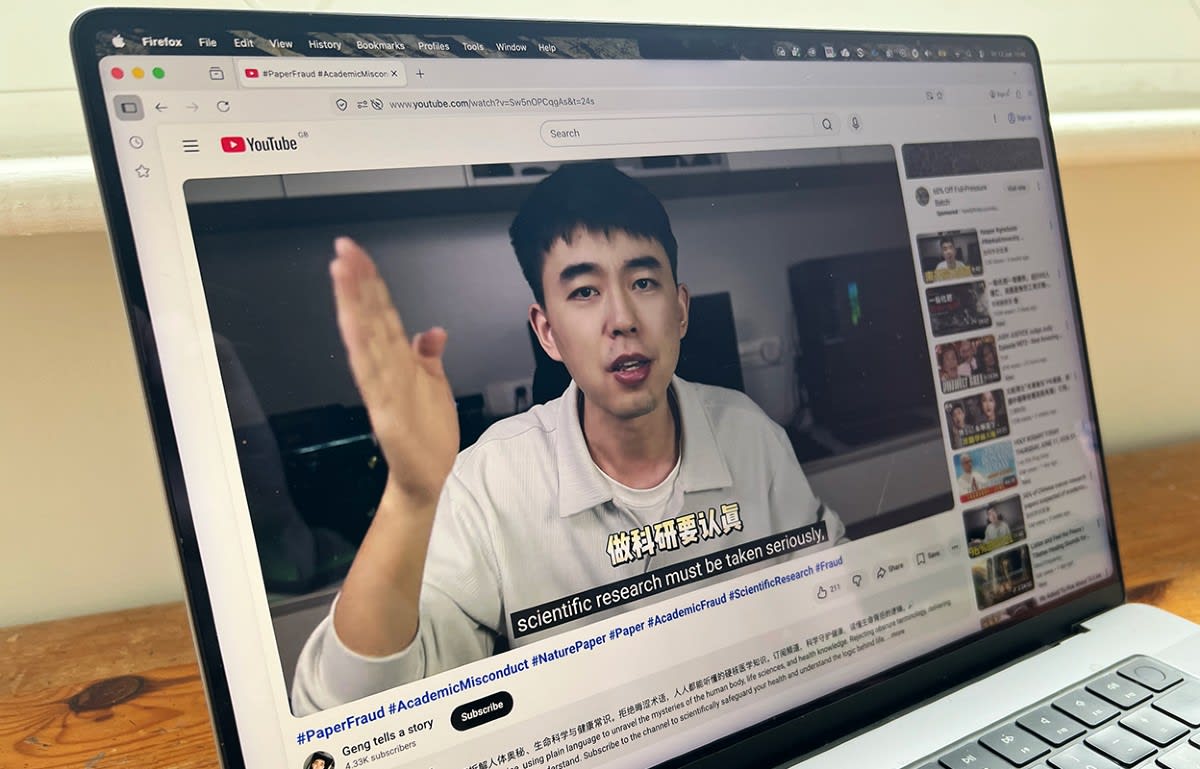
Chinese PhD Student Exposes Data Fraud, Reforms 4 Universities
A former PhD student's viral videos caught senior scientists falsifying research data, leading four major Chinese universities to fire researchers and strengthen integrity policies. His detective work reached 10 million viewers and sparked sweeping reforms across China's academic system.
A blogger armed with spreadsheet skills just changed how China's top universities police scientific honesty.
Geng Hongwei, a former PhD student known online as "Student Geng," posted five-minute videos in April and May breaking down suspicious patterns in published research papers. His analysis was simple but devastating: in one study published in Nature, 76% of data points ended in the number five, while only 6% ended in six. The odds of that happening naturally? Astronomically low.
"Are you telling me that these figures are authentic?" Geng asked viewers, pointing out table after table where numbers seemed too convenient to be real. In another paper about cancer treatment, he showed how 64 data points on one spreadsheet had identical decimal patterns to those in the exact same positions on another sheet.
His videos exploded across Chinese social media, racking up nearly 10 million views. Within days, four major universities launched investigations into the five senior academics Geng had named.
The response was swift and serious. Tongji University in Shanghai removed Wang Ping from his position as dean of life sciences, demoted him two professional levels, and suspended his hiring power and salary increases for two years. The researcher who fabricated the data, Jin Jiali, was fired outright.
Nankai University in Tianjin and Sun Yat-sen University in Guangzhou followed with similar actions. Chen Quan lost his dean position at Nankai's College of Life Sciences. Multiple researchers were dismissed, and corresponding authors who failed to catch the fabrications faced sanctions.
The Ripple Effect
The scandal is transforming Chinese academic culture in real time. All three universities that completed investigations publicly pledged to strengthen oversight of students and faculty. They're building systems to catch data problems before publication, not after viral exposure.
Nature's publisher confirmed all flagged papers are under careful investigation, with independent experts reviewing the concerns. Editor's notes now alert readers that the data's reliability is being questioned.
Geng identified irregularities in four additional Nature portfolio papers but chose not to name their authors yet, giving institutions time to investigate privately. His approach balanced accountability with fairness, turning whistleblowing into constructive reform rather than just public shaming.
The impact extends beyond individual careers. By making complex statistical analysis accessible through short, engaging videos, Geng showed that research integrity isn't just for insiders. Millions of ordinary people now understand why fabricated data matters and how to spot red flags.
Chinese universities are responding not with defensiveness but with action, using this moment to rebuild trust in their research. When one former student's careful work can reach 10 million people and prompt institutional change at four major universities, the system is working exactly as it should.
More Images


Based on reporting by Nature News
This story was written by BrightWire based on verified news reports.
Spread the positivity!
Share this good news with someone who needs it