Chinese Scientists Prove 90-Year-Old Theory on Dark Matter
Researchers in China just confirmed a forgotten 1930s physics theory that could finally help us detect the invisible substance holding the universe together. The breakthrough opens a new path to understanding dark matter, one of science's biggest mysteries.
After nearly 90 years of waiting, a team of Chinese scientists just proved that a Soviet physicist's bold idea was right all along.
Back in the 1930s, Arkady Migdal proposed something revolutionary: when invisible particles like dark matter hit an atom's nucleus, they don't just bounce off. They also knock loose an electron, creating a tiny signal we could actually measure.
For decades, the Migdal effect existed only on paper. No one had the technology to prove it was real, and the theory gradually faded from scientific conversations until the mid-2000s.
Now researchers at the University of the Chinese Academy of Sciences have changed everything. Using advanced detection equipment, they captured direct evidence of the Migdal effect for the first time in history.
"For more than 80 years, the Migdal effect in neutral particle collisions had never been directly confirmed by experiments," said Professor Zheng Yangheng, who led the study published in Nature.
The team built a specialized detector filled with helium and dimethyl ether gas, then bombarded it with neutrons. Over 150 hours, they collected data from 100 collision events and identified six strong candidates that matched Migdal's predictions perfectly.
Their findings reached "5 sigma" statistical significance, the gold standard in physics that means the results are almost certainly real and not just random chance.
Why This Inspires
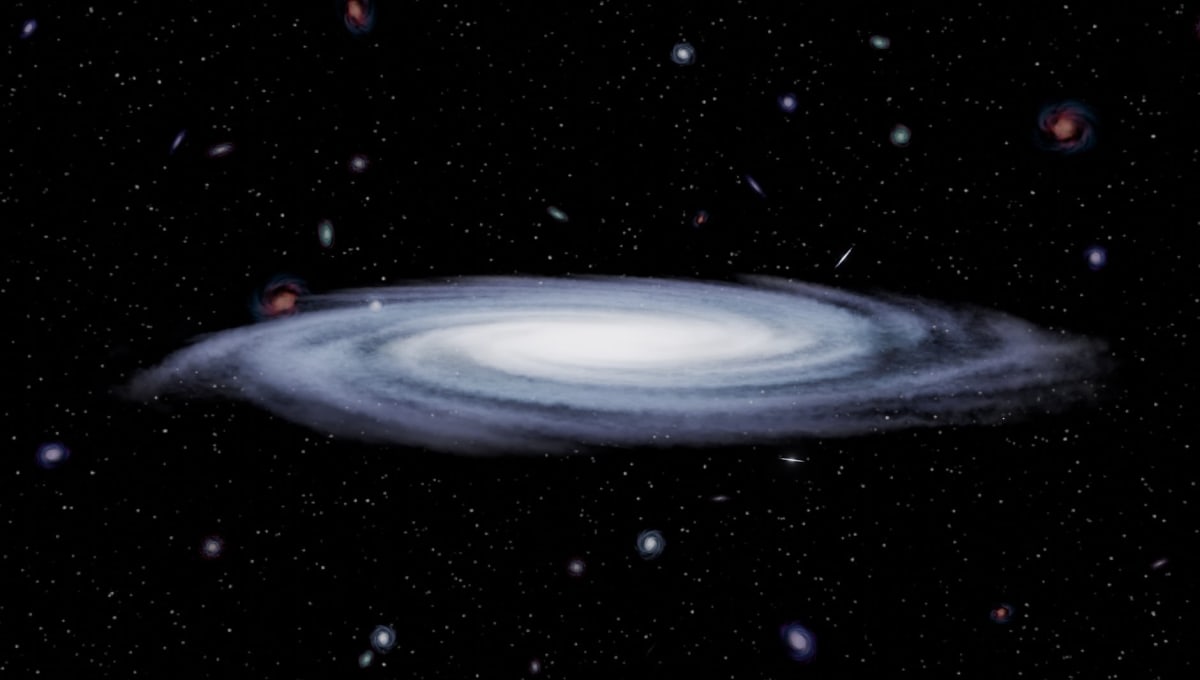
This discovery matters because dark matter is everywhere yet nowhere we can see. Scientists believe this invisible substance makes up 27 percent of the universe, acting like cosmic glue that holds galaxies together.
Without dark matter's extra gravity, galaxies would spin so fast they'd fly apart. We see its effects everywhere we look in space, but we've never directly detected a single dark matter particle despite decades of searching.
Previous experiments focused on finding heavy dark matter particles and came up empty. The Migdal effect offers a promising new approach for detecting lighter dark matter particles that might have been slipping through our nets all along.
The breakthrough provides an experimental foundation that other researchers can build on. What started as one physicist's theoretical hunch in the 1930s could become the key that unlocks one of the universe's deepest secrets.
Sometimes the answers we need have been waiting patiently in old notebooks, just ready for technology to catch up with imagination.
More Images


Based on reporting by Google News - Researchers Find
This story was written by BrightWire based on verified news reports.
Spread the positivity!
Share this good news with someone who needs it