Chinese Team Hits 28% Efficiency in New Solar Cell Design
Researchers in China just set a world record for solar cell efficiency, bringing us closer to lightweight, flexible panels that could power everything from wearable devices to spacecraft. The breakthrough could reshape how we think about where solar energy can go.
Scientists in China have achieved something remarkable: a solar cell that converts 28.04% of sunlight into electricity, the highest efficiency ever recorded for its type.
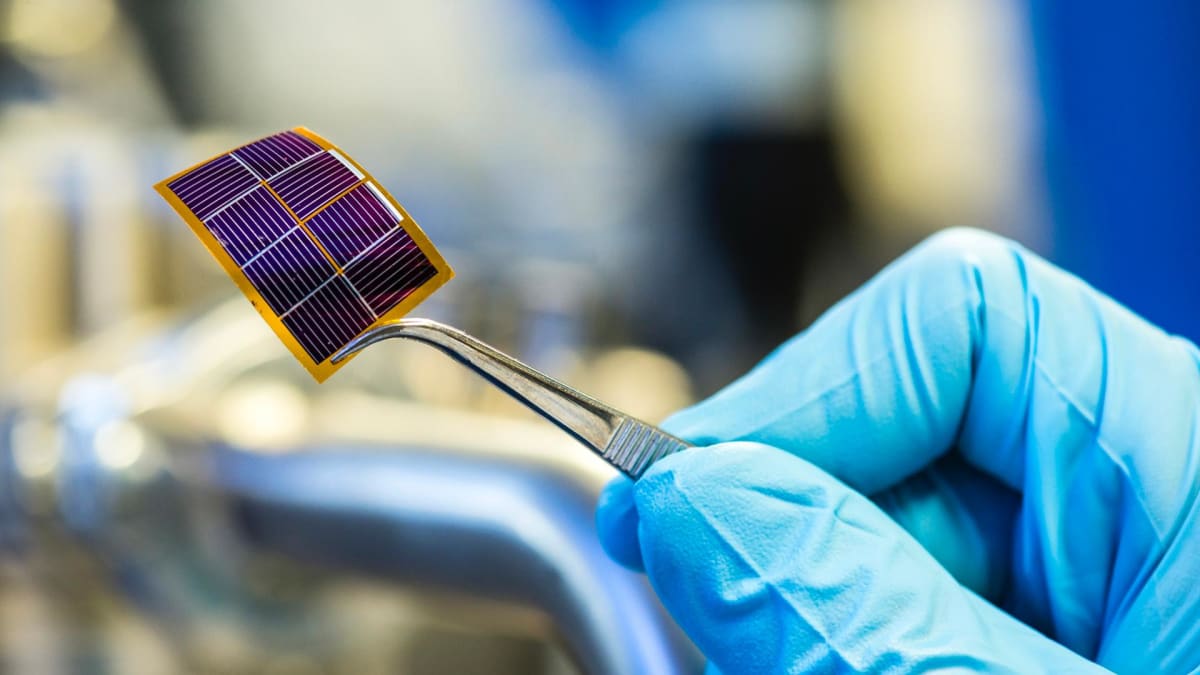
The team from the Chinese Academy of Sciences, led by Academician Li Yongfang and researcher Meng Lei, built what's called a perovskite-organic tandem solar cell. Unlike the bulky silicon panels you see on rooftops, this design stacks two ultra-thin materials that each capture different colors of light.
Think of it like having two nets instead of one. Each layer catches what the other misses, squeezing more energy from every ray of sunshine while staying thin, light, and bendable.
The real breakthrough came from solving a problem that has held this technology back for years. These advanced solar cells used to degrade quickly and lose power over time, making them impractical for real-world use.
The researchers introduced a new additive molecule called TDB that stabilizes the materials during manufacturing and while operating in sunlight. In testing, the solar cell kept 90% of its original efficiency after 625 hours of continuous sunlight, a major leap in durability.
Third-party certification confirmed the 28.04% efficiency rating, officially making it the world's most efficient perovskite-organic tandem solar cell. The study was published in Nature, one of the world's top scientific journals.
The Ripple Effect
This isn't just about breaking records. The technology opens doors to solar power in places traditional panels can't go.
Buildings could integrate these flexible cells directly into windows or walls without adding weight. Drones and satellites could carry their own lightweight power sources for longer missions. Emergency responders might use portable solar chargers that fold into a backpack.
Even your jacket could one day charge your phone while you walk. The possibilities expand when solar panels become as flexible as fabric and light as paper.
The researchers say their design could eventually work for transportation, wearables, and space applications where every gram matters. Countries in the Middle East are already embracing Chinese solar technology for their green energy transitions, and this advancement could accelerate that shift.
Solar energy keeps getting better, and today it took another leap forward.
More Images

Based on reporting by Google News - Solar Power Record
This story was written by BrightWire based on verified news reports.
Spread the positivity!
Share this good news with someone who needs it