Climate Scientist Tracks AI Energy Use: Results Surprise
A climate researcher spent eight weeks tracking every AI prompt he sent and discovered modern AI agents use 600 times more energy than simple chatbots. His findings reveal a critical gap between what tech companies report and how people actually use AI today.
When climate scientist Zeke Hausfather realized he was using AI daily for research, he wondered about the energy cost of all those prompts. So he did what scientists do best: he tracked every single one of his 1,138 AI queries over eight weeks.
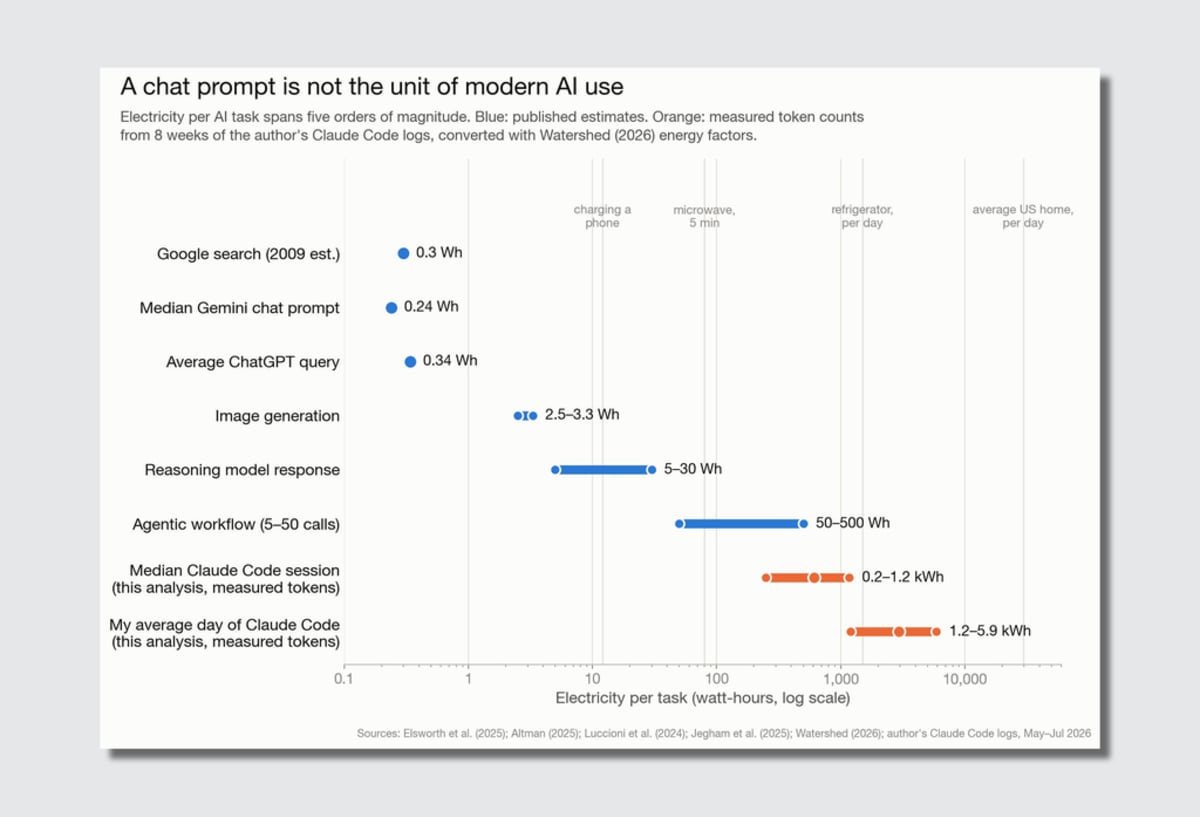
The results surprised even him. His typical prompt used about 150 watt-hours of energy, roughly 600 times more than what tech giants like Google and OpenAI claim for simple chatbot queries.
Here's why the gap exists. Tech companies base their estimates on old-fashioned chatbot conversations, the kind where you ask one question and get one answer. But that's not how most people use AI anymore.
Today's AI agents work differently. You give them complex instructions, and they spin up multiple sub-agents that work together on massive tasks. Hausfather used this "agentic AI" for data analysis and research, processes far more energy-intensive than asking ChatGPT for a recipe.
Hausfather calculated his energy use by tracking tokens, the chunks of text AI models process. Since energy costs make up a big part of running these models, he could estimate electricity use from token pricing. He admits it's not perfect, but it's more accurate than outdated company estimates.
In the AI world, a year changes everything. What seemed cutting-edge twelve months ago now looks quaint compared to how we're actually using these tools.
The Bright Side
Individual use remains manageable. Hausfather's heavy AI usage over eight weeks consumed about as much electricity as running an electric dryer for a year. For most people doing occasional AI tasks, the personal impact stays minimal.
The real value lies in transparency. By sharing his methodology and findings, Hausfather gives others a framework to understand their own AI energy footprint. His research pushes tech companies toward honest conversations about energy use.
This matters because awareness drives innovation. When we understand the true energy costs, developers can build more efficient AI systems and users can make informed choices about when complex AI agents are truly necessary.
The bigger picture does warrant attention. Some estimates suggest AI data centers could consume 12% of all U.S. electricity by 2030. But knowing the problem means we can solve it with better technology, smarter usage, and cleaner energy sources.
Hausfather's experiment shows how individual scientists can illuminate important questions when corporations stay silent.
More Images

Based on reporting by Fast Company - Innovation
This story was written by BrightWire based on verified news reports.
Spread the positivity!
Share this good news with someone who needs it