Common Cholesterol Drug Shows Promise as Breakthrough Treatment for Aggressive Breast Cancer
Researchers have discovered that pitavastatin, a widely-used cholesterol medication, can effectively combat one of the most challenging forms of breast cancer. This exciting finding could transform treatment options for patients who have run out of alternatives, offering new hope through an already-safe, accessible medication.
In a discovery that brings fresh hope to patients facing one of the most aggressive forms of breast cancer, researchers at Korea University have found that a common cholesterol-lowering medication could be a game-changer in treatment.
Professor Jae Hong Seo and his dedicated team have revealed that pitavastatin—a medication millions already take safely for heart health—shows remarkable effectiveness against triple-negative breast cancer (TNBC), even when traditional chemotherapy stops working. Their groundbreaking findings were recently published in Experimental Hematology & Oncology.
What makes this discovery particularly exciting is that it addresses a critical challenge in cancer treatment. While TNBC often responds well initially to chemotherapy, some resilient cancer cells can survive and cause the disease to return. These stubborn cells, known as cancer stem-like cells, have been a major obstacle in achieving lasting remission for patients.
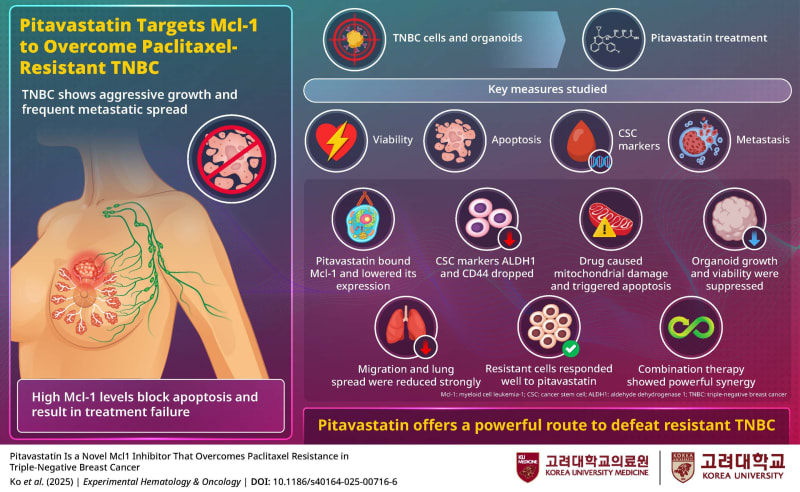
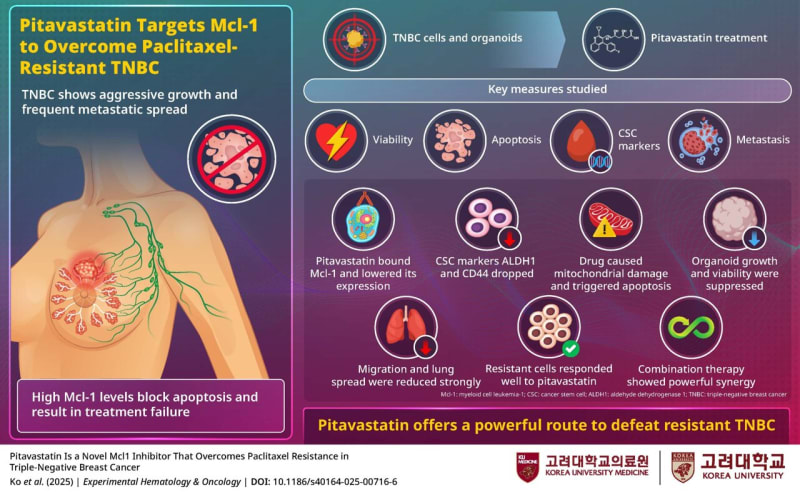
The research team discovered that pitavastatin works by targeting a specific protein called Mcl-1, which helps cancer cells survive and resist treatment. By blocking this protein, the medication effectively eliminates the cancer stem-like cells that chemotherapy often leaves behind. "We report for the first time that pitavastatin is a direct inhibitor of Mcl-1 and targets heterogeneity in TNBC cells," Professor Seo explained enthusiastically.
The results have been remarkably promising across multiple testing platforms. In laboratory studies using patient-derived cancer organoids—miniature tumor models grown from actual patient tissue—pitavastatin significantly reduced both tumor size and viability. When tested in animal models, the medication substantially decreased tumor growth, prevented the formation of new blood vessels that feed tumors, and most importantly, blocked the cancer from spreading to the lungs.
Perhaps most encouraging is what happened when pitavastatin was tested on cancer cells that had become resistant to paclitaxel, a standard chemotherapy drug. These notoriously difficult-to-treat cells remained highly sensitive to pitavastatin. Even better, when pitavastatin was combined with paclitaxel, the two drugs worked together synergistically, achieving better results than either medication alone.
The safety profile adds another layer of optimism to this discovery. Throughout the animal studies, pitavastatin demonstrated its anti-cancer effects without causing organ damage or significant weight loss—common concerns with cancer treatments. This excellent safety record makes sense, given that pitavastatin has been prescribed safely to millions of people worldwide for cardiovascular health.
"Our results support pitavastatin as a promising candidate for drug repurposing, particularly in TNBC characterized by high Mcl-1 expression and resistance to conventional chemotherapy," Professor Seo concluded with evident optimism.
The beauty of this discovery lies in its potential for rapid translation to patient care. Because pitavastatin is already approved and well-understood by physicians, the pathway to clinical trials and potential treatment could be significantly faster than developing an entirely new drug from scratch. This approach, known as drug repurposing, offers hope that patients could benefit from this discovery sooner rather than later.
For patients and families affected by TNBC, this research represents more than just scientific progress—it's a beacon of hope that innovative thinking and dedicated research continue to unlock new possibilities in the fight against cancer.
More Images

Based on reporting by Medical Xpress
This story was written by BrightWire based on verified news reports.
Spread the positivity! 🌟
Share this good news with someone who needs it
More Good News
 🧘 Health & Wellness
Breakthrough Imaging Tool Brings New Hope for Bladder Cancer Patients
Cancer Breakthrough: Scientists Create Powerful New Immune-Boosting Treatment
 🧘 Health & Wellness
Revolutionary Breath-Based Glucose Monitor Brings Hope to Millions of Diabetics
Joke of the Day
Why did the librarian get kicked out of class?
Explore Categories
Quote of the Day
"Do not go where the path may lead, go instead where there is no path and leave a trail."
— Ralph Waldo Emerson