Cosmic Champagne: Astronomers Capture Stunning Galaxy Cluster Merger
Scientists capture a stunning image of two galaxy clusters colliding in space, revealing complex cosmic interactions and challenging our understanding of universal dynamics. The 'Champagne Cluster' offers unprecedented insights into dark matter and galactic mergers.
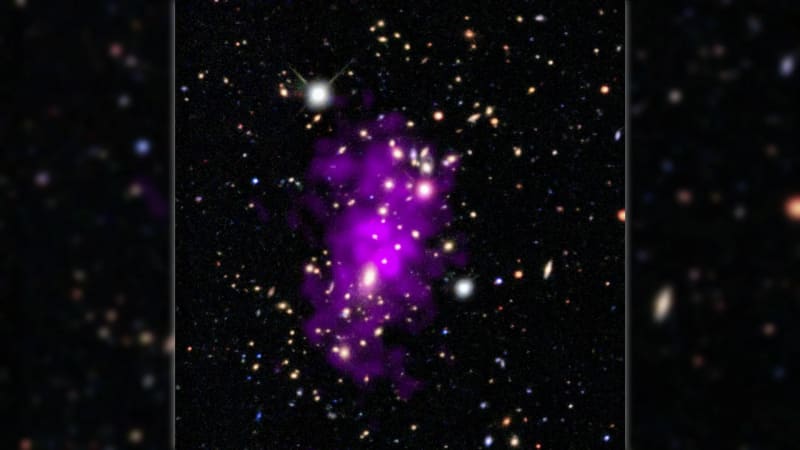
In a dazzling astronomical New Year's celebration, scientists have unveiled a breathtaking image of two galaxy clusters dramatically colliding in deep space, nicknamed the "Champagne Cluster" for its effervescent appearance and the serendipitous date of its discovery.
Astronomers first identified this celestial phenomenon on December 31, 2020, using data from NASA's Chandra X-ray Observatory and optical telescopes. The cluster, officially named RM J130558.9+263048.4, reveals a complex cosmic dance of massive galactic structures merging in a spectacular display that challenges our understanding of universal dynamics.
The composite image shows two galaxy clusters in mid-collision, with superheated gas stretching dramatically from top to bottom - a telltale sign of an ongoing merger. Unlike typical galaxy clusters that appear circular, this formation shows two distinct concentrations of galaxies, one above and one below the center, highlighting the intricate process of cosmic consolidation.
Remarkably, the hot gas in this forming cluster actually outweighs the combined mass of over one hundred galaxies. Even more intriguing, the cluster contains vast quantities of dark matter - the invisible material believed to permeate the universe - making it a critical site for understanding fundamental cosmic mechanisms.
Researchers from the University of California, Davis - including Faik Bouhrik, Rodrigo Stancioli, and David Wittman - have proposed two fascinating scenarios for this cluster's formation. One suggests the clusters collided over two billion years ago, separated, and were pulled back together by gravitational forces. An alternative theory proposes a single collision around 400 million years ago, with the clusters currently moving apart.
The Champagne Cluster belongs to a rare category of merging galaxy clusters, drawing comparisons to the famous Bullet Cluster. Scientists believe studying such formations could provide unprecedented insights into dark matter behavior during high-speed cosmic interactions. The comprehensive research was recently published in The Astrophysical Journal, offering a tantalizing glimpse into the complex mechanisms driving universal evolution.
Managed by NASA's Marshall Space Flight Center and the Smithsonian Astrophysical Observatory, this groundbreaking observation represents another leap forward in our understanding of the magnificent, ever-changing cosmic landscape.
Based on reporting by Science Daily
This story was written by BrightWire based on verified news reports.
Spread the positivity! 🌟
Share this good news with someone who needs it
More Good News
 🚀 Innovation
NASA's Innovative Tech Paves the Way for Human Mars Exploration
 🚀 Innovation
Cosmic Celebration: NASA Reveals Dazzling 'Champagne Cluster' in Spectacular New Image
 🚀 Innovation