Danish Physicist's 1820 Classroom Twitch Changed Science
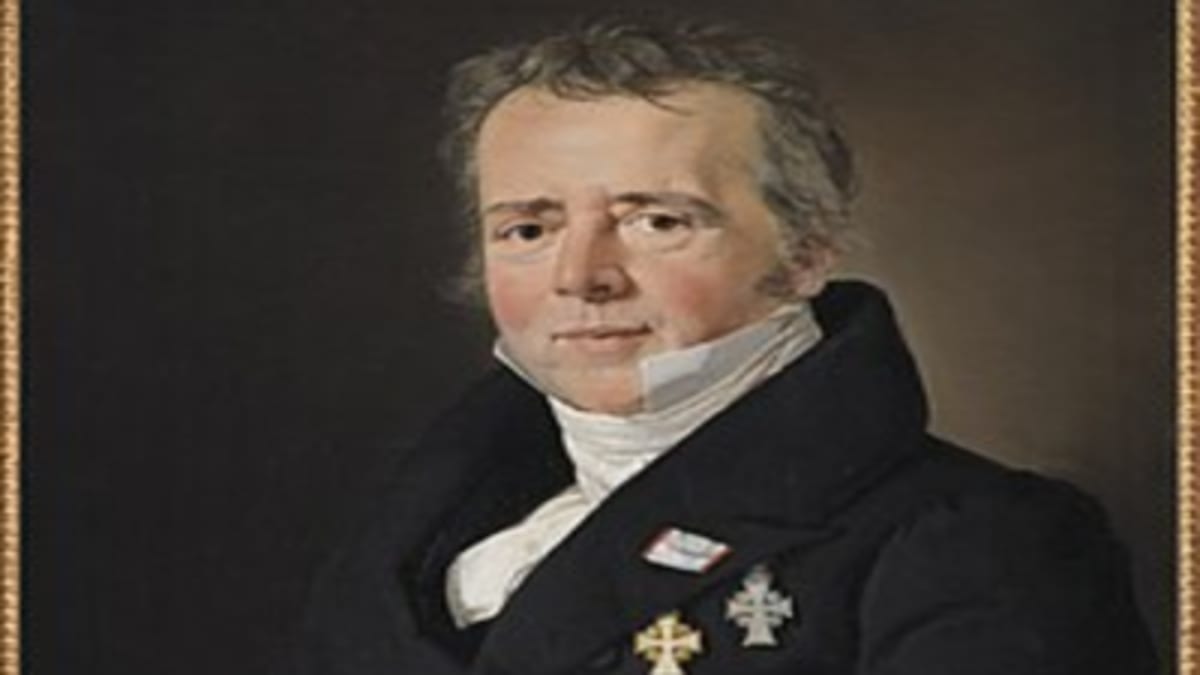
A compass needle moved near a wire during a lecture in 1820, and Danish physicist Hans Christian Ørsted noticed something nobody had seen before. That tiny twitch proved electricity and magnetism were connected, launching the entire field of electromagnetism.
Imagine changing the world forever because you paid attention to a wobbly compass needle during class. That's exactly what happened when Hans Christian Ørsted was preparing a lecture demonstration in 1820.
The Danish physicist connected a simple battery to a wire, and when current flowed through it, a nearby compass needle deflected. The movement lasted only moments, but Ørsted realized he was witnessing something revolutionary: electricity was creating a magnetic field.
What makes this discovery remarkable is how ordinary the moment was. No fancy laboratory, no complex machinery, just basic classroom equipment and a curious mind. Students were likely in the room when it happened, watching their professor stumble onto one of physics' fundamental principles.
Before this moment, scientists studied electricity and magnetism as completely separate forces of nature. Ørsted's twitching needle proved they were intimately connected. When he switched the current on and off, the needle responded each time, confirming the effect was real and repeatable.
The scientific community moved fast after Ørsted published his findings. Within years, researchers like André-Marie Ampère and Michael Faraday built on his work, developing the laws of electromagnetism that power our modern world. Every electric motor, generator, and transformer traces its lineage back to that classroom demonstration.
Ørsted's contribution became so fundamental to physics that scientists named a unit of measurement after him. The "oersted" measures magnetic field strength, ensuring his name appears in physics textbooks and laboratories worldwide forever.
Why This Inspires
This story reminds us that world-changing discoveries don't always need billion-dollar research facilities or decades of planning. Sometimes they happen in classrooms, with everyday tools, when someone asks the right question at the right moment.
Ørsted could have dismissed the needle's movement as a quirk or equipment error. Instead, he investigated, documented, and shared his observation with the world. His intellectual curiosity transformed a fleeting classroom anomaly into the foundation of electromagnetic theory.
The discovery also highlights how teaching and research feed each other. Ørsted wasn't locked away in isolation; he was preparing to educate students when inspiration struck. That learning environment, with its mix of demonstration and explanation, created the perfect conditions for breakthrough thinking.
Today, every smartphone, computer, and power grid exists because a professor noticed something strange and refused to ignore it. The battery and wire setup Ørsted used couldn't have been simpler, yet it unlocked technologies that define modern civilization.
From medical imaging to renewable energy, from radio waves to particle accelerators, electromagnetism shapes nearly every aspect of contemporary life. And it all started with one attentive scientist and a compass needle that moved at exactly the right moment.
More Images



Based on reporting by Google: scientific discovery
This story was written by BrightWire based on verified news reports.
Spread the positivity!
Share this good news with someone who needs it