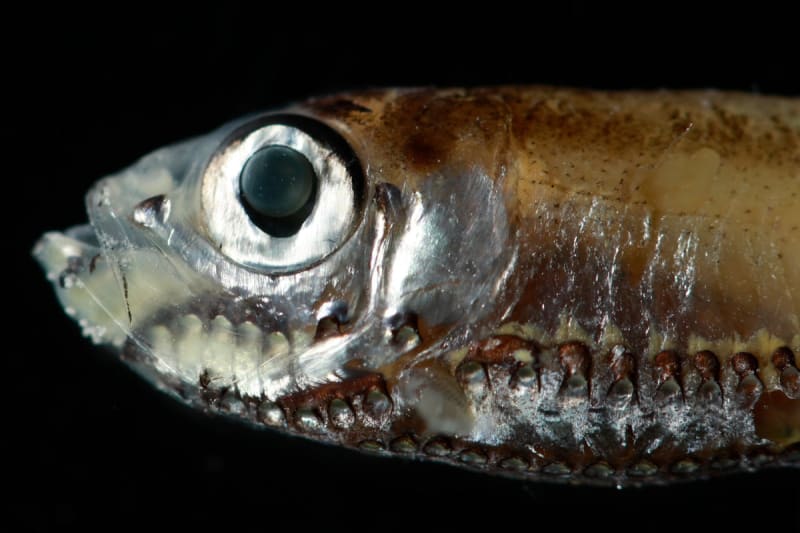
Deep-Sea Fish See in the Dark With Hybrid Eye Cells
Scientists discovered three Red Sea fish species have special "hybrid" eye cells that let them see in the ocean's darkest depths. This breakthrough could reshape what we know about how vision evolved in all animals with backbones.
Imagine trying to see in water so dark that normal eyes just don't work. That's the challenge facing baby fish in the ocean's twilight zone, and scientists just discovered their brilliant solution.
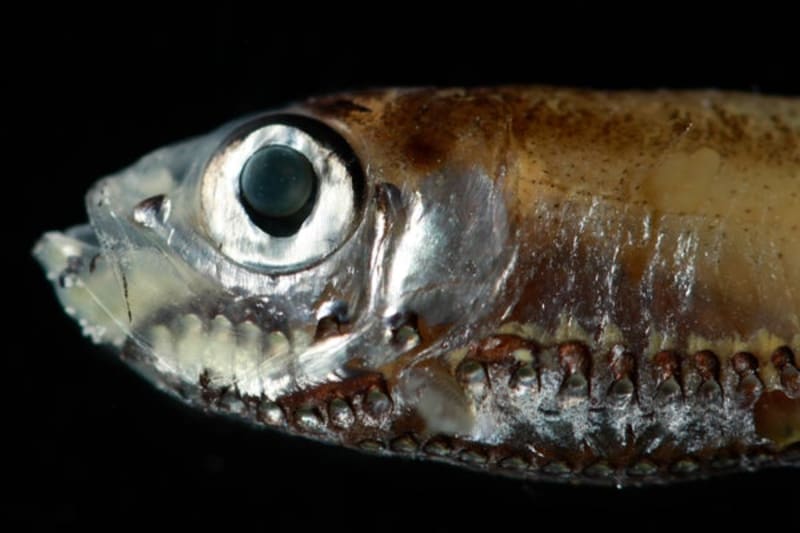
Researchers found three species of Red Sea fish with revolutionary "hybrid" photoreceptors in their retinas. These special cells blend features of both cones (which see color in bright light) and rods (which work in darkness), giving the fish a superpower most vertebrates don't have.
The discovery came from studying larvae of hatchetfish, lanternfish, and lightfish. All three start life in the murky midwater depths where neither typical cone nor rod cells work well. Lead researcher Lily Fogg from the University of Basel calls it "a bit of a nightmare" from a visual perspective.
Yet these tiny larvae need to eat, avoid becoming someone else's dinner, and survive long enough to grow up. The hybrid cells solve that puzzle perfectly. Hatchetfish keep these special cells throughout their entire lives, while the other two species eventually develop standard rod cells as adults.
The findings flip conventional wisdom about vertebrate vision. Scientists used to think photoreceptors existed in just two rigid categories. Now the evidence suggests they exist along a spectrum, adapting to whatever environment an animal needs to thrive in.
Why This Inspires
This discovery reminds us that nature constantly innovates in ways we're only beginning to understand. Similar hybrid cells have turned up in jawless fishes, some reptiles, and amphibians, suggesting this flexibility might be an ancient feature built into vertebrate DNA.
The research, published in Science Advances, opens new doors for understanding how sight developed across hundreds of millions of years of evolution. What seemed like a simple binary system turns out to be far more elegant and adaptable.
As Fogg puts it, "It's a reminder that biology is rarely as simple as we think it is." These deep-sea fish spent millennia perfecting a solution we're only now learning to appreciate, proving once again that the natural world still has countless secrets waiting to teach us.
The ocean's darkest zones just got a little brighter thanks to fish that refused to be limited by how eyes are "supposed" to work.
More Images


Based on reporting by Scientific American
This story was written by BrightWire based on verified news reports.
Spread the positivity!
Share this good news with someone who needs it